
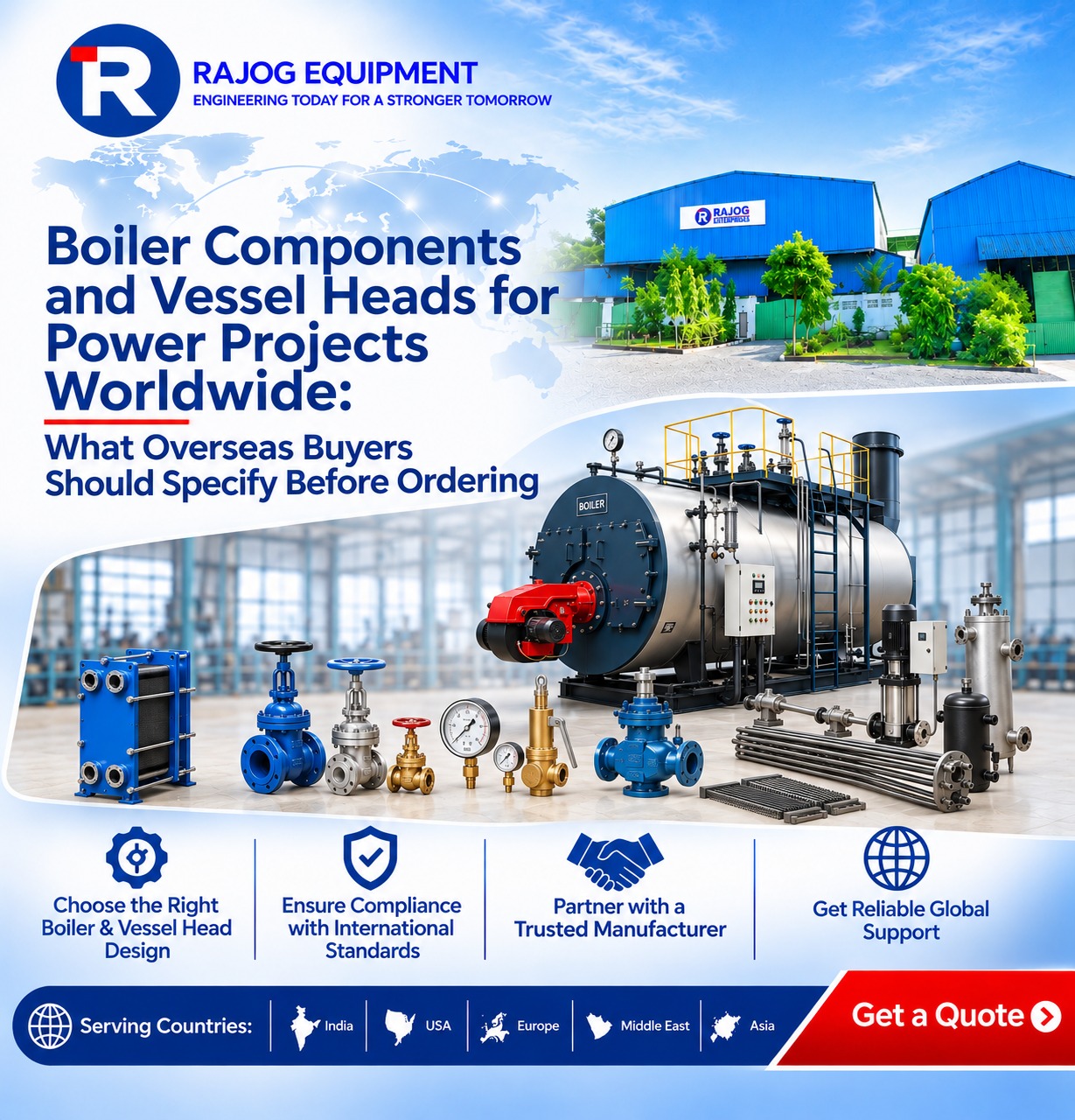
Introduction
Every power project depends on equipment that works under heat and pressure for years without surprises. Boilers, heat exchangers and pressure vessels rely on heavy formed and fabricated parts: vessel heads, dished ends, rolled shells, tube sheets and other boiler components.
If one of these parts arrives late or fails inspection, the whole installation schedule feels it. For overseas project teams, India is a practical source for these components. The best results come when the buyer specifies the order clearly before production begins.
This guide explains what global buyers should specify before ordering boiler components and vessel heads, so the manufacturer can quote accurately, build correctly and deliver without delays.
What Are Boiler Components and Vessel Heads?
Vessel heads, also called dished ends, close the ends of pressure vessels, drums and tanks. Common shapes include torispherical, semi-elliptical and hemispherical heads. They are formed from plate by pressing or spinning; larger heads may be built from a crown and several petals welded together.
Boiler components include the pressure-retaining and supporting parts used in steam and heat generation: shells, drums, heads and tube sheets. These parts usually face stricter rules on material, welding, inspection and records than general fabrication.
Where Power Project Demand Comes From
Buyers in different regions work on different kinds of projects:
- <strong>Middle East:</strong> Power generation and desalination projects in the UAE, Saudi Arabia, Qatar and Oman often require strict documentation and inspection.
- <strong>Africa:</strong> Power stations, sugar mills, fertilizer units and refineries in Kenya, South Africa and Nigeria need rugged vessel heads, shells and heat exchanger components that can be maintained locally.
- <strong>Asia-Pacific:</strong> Boiler and power plant projects in Indonesia, along with mining and process plants in Australia, call for heavy tube sheets, rolled shells and dished ends.
Stage 1: Before the Enquiry - Get the Specification Right
Most boiler component problems begin before the first plate is cut, with an enquiry that leaves out a key detail.
1. State the Design Code and Approvals
The design code decides thickness, shape limits, welding rules, testing and documentation. Boiler parts may also fall under the destination country's boiler regulations, which can require approval or witnessing by an authority. State the design code, applicable regulations and approval requirements in the first enquiry.
2. Define the Head Geometry and Thickness
For each vessel head, specify the type, inside or outside diameter reference, nominal thickness, crown radius, knuckle radius and straight flange length. Mention planned openings, nozzles or manways and whether the head is a single piece or is built from a crown and petals.
Pressing stretches the plate in the knuckle area, making it thinner than the nominal plate. State the required minimum thickness after forming, not only the starting plate thickness. Custom pressure vessel dished ends may be feasible up to 110 mm thickness, subject to the exact diameter and material combination.
3. Specify Material and Heat Exchanger Details
Share the material grade, impact-testing or chemical limits and approved-mill requirements for high-temperature and high-pressure applications. If the buyer supplies the plate, state this clearly so the material can be verified on arrival.
For tube sheets and baffles, specify diameter, thickness, hole pattern, pitch, tolerances and tube joint method. Ordering heads, shells and tube sheets from one supplier reduces coordination between vendors and keeps part fit consistent.
Stage 2: During Production - Forming, Welding and Machining
Once production starts, forming, welding and machining determine whether the parts remain on schedule.
4. Confirm Welding and Heat Treatment
Pressure-part welding must follow qualified procedures and be performed by qualified welders. Confirm existing approved procedures and whether qualification is required. State heat-treatment requirements early because they affect planning and capacity. For large sectional heads, agree how the crown and petals will be joined, examined and tested.
5. Define Machined Features Clearly
Boiler and pressure parts frequently require flange faces, bores, nozzle openings and bevels. Heavy CNC machining requires handling and machine capacity suited to component size and weight. Highlight critical features and tolerances, and agree whether machining occurs before or after welding because welding can move the plate.
6. Control Drawing Revisions
Agree how revisions are communicated and confirmed. No component should be built to an outdated drawing, especially when nozzle locations, interfaces or thickness requirements change.
Stage 3: At Inspection - Prove the Specification
Power projects normally require documented proof at several stages.
7. Set the Inspection Plan and Hold Points
A third-party inspection plan may include material verification, dimensional checks after forming, weld inspection, non-destructive testing, pressure testing and a final review against the approved drawing. Agree hold points, attendance and notice periods before production.
Where travel is difficult, confirm whether remote witnessing through video and photographs is acceptable under the project rules.
8. Prepare the Documentation Package in Parallel
Documentation is often discussed too late and then becomes the first cause of dispatch delay. Typical records include material test certificates, welding procedures, welder qualifications, NDT reports, dimensional and pressure-test reports and a final data book.
List every document, required format and approval route in the enquiry so records can be prepared as production progresses.
Stage 4: At Shipping - Protect the Component
A good part can still arrive damaged or late if shipping is planned at the last moment.
9. Agree Packing, Incoterms and the Destination Port
Heavy heads and shells require proper supports, approved lifting points and protection against moisture and transit damage. Surface preservation should suit the sea journey and storage period before installation.
Confirm who arranges freight, insurance and export documents. Common terms include FOB Nhava Sheva or CIF to a named destination port such as Jebel Ali, Dammam, Mombasa, Singapore or Fremantle.
Specification Checklist for Your Enquiry
- Latest drawing revision with all key dimensions
- Design code, regulations and approval requirements
- Head type, diameter reference, crown and knuckle radius and straight flange
- Nominal thickness and minimum thickness after forming
- Material grade, additional tests and approved mills
- Tube sheet diameter, hole pattern, pitch and tolerance
- Welding, heat treatment and NDT requirements
- Machined features and tolerances
- Inspection plan, hold points and witnessing method
- Documentation list and format
- Surface treatment, packing and preservation
- Quantity, delivery terms, destination port and delivery date
Questions to Ask a Boiler Component Supplier
- Which vessel head types, diameters and thicknesses do you regularly form?
- How do you verify minimum thickness after forming?
- Which welding procedures are already qualified?
- Do you support third-party inspection and remote witnessing?
- Can plate rolling, forming, welding and CNC machining be done under one roof?
- How do you prepare documentation during production?
- How do you pack and ship heavy and oversized parts?
How Rajog Supports Global Power Project Buyers
Rajog Equipment is a heavy engineering and CNC machining company in India supplying boiler components, vessel heads, heavy rolled shells, dished ends and heat exchanger components to export buyers.
Plate rolling, forming, fabrication, deep-hole drilling and heavy CNC machining can be coordinated in one setup, reducing handoffs between vendors. Buyers who share the design code, thickness requirement and documentation needs early allow the team to plan the work from the first quotation.
Final Takeaway
Boiler components and vessel heads are simple to describe and difficult to get right without a complete specification. A stated design code, clear head geometry, minimum thickness after forming, suitable material, qualified welding, planned inspection, early documentation and agreed shipping terms give a supplier everything needed to deliver on schedule. Overseas power project teams who settle these points before ordering protect their timeline and make quotations easier to compare fairly.