
Introduction
A heat exchanger can look perfect from the outside and still underperform because of something almost invisible: the holes in its tube sheet. The tube sheet holds every tube in position, separates the shell side from the tube side, and carries pressure, temperature and mechanical loads throughout its service life. Hundreds or even thousands of holes must be drilled in the right place, at the right size, with the right finish. Industries such as oil and gas, desalination, pharmaceuticals, fertilizers, power generation and heat transfer depend on heat exchangers that run for years under demanding conditions. When drilling accuracy is poor, problems often appear during tube insertion, tube expansion, welding, pressure testing or service, when correction is expensive. This is why CNC deep hole drilling is one of the most important processes in modern tube sheet manufacturing.
What Is CNC Deep Hole Drilling in Tube Sheet Manufacturing?
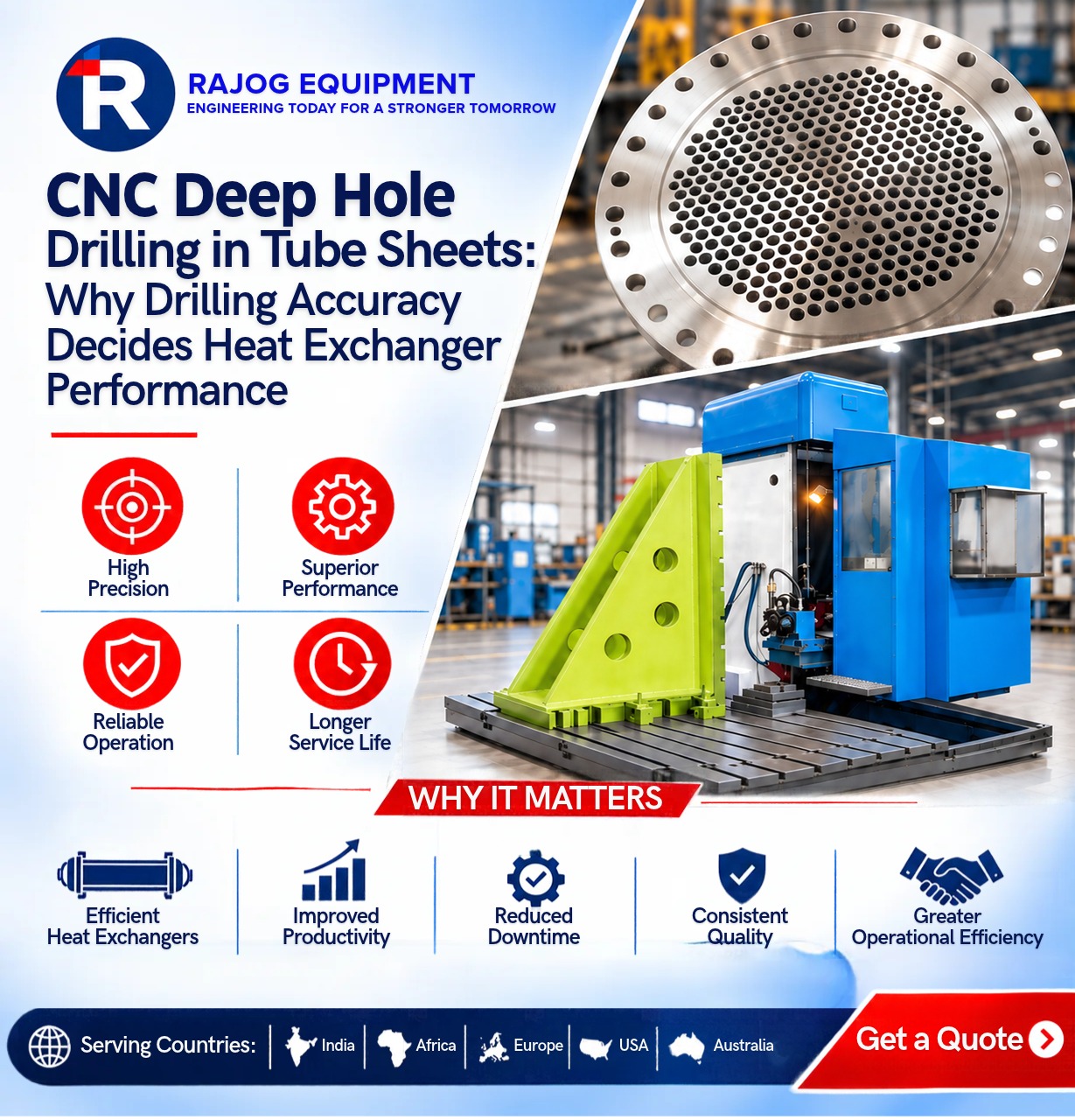
A tube sheet is a thick plate, often circular, drilled with a precise pattern of holes that receive the heat exchanger tubes. Because tube sheets are thick and the holes are small compared with their depth, conventional drilling can struggle to keep each hole straight and accurate. CNC deep hole drilling uses specialised machines and tooling for high depth-to-diameter ratios. The machine follows the hole pattern from the drawing and drills through the full thickness with controlled feed, speed and coolant delivery. Compared with manual layout and conventional drilling, this improves repeatability across the whole plate and shortens drilling time on large tube sheets. Rajog offers CNC deep hole drilling for tube sheets up to 4000 mm in diameter, with hole sizes from 12 to 40 mm and drilling depth up to 1000 mm.
Hole Position Accuracy and Pitch Control
Tubes must enter the tube sheet freely and sit in the exact pattern the thermal design assumes. If hole positions drift, tubes may bind during insertion, baffles may not align, and the tube bundle may become difficult to assemble. Pitch, the distance between hole centres, also influences the strength of the metal between holes and shell-side flow behaviour. CNC positioning helps maintain consistent pitch across the full plate rather than allowing small errors to accumulate. Buyers should confirm the permissible position tolerance in the drawing and ask how the manufacturer verifies pitch after drilling.
Hole Diameter Tolerance
The tube hole diameter must suit the tube outside diameter and the method used to join the tube to the tube sheet. A hole that is too tight can make insertion difficult. A hole that is too loose may reduce the contact needed for a reliable expanded joint or make welding more difficult. Hole diameter and tolerance should therefore be stated clearly before manufacturing starts. Buyers should also confirm whether diameter is checked on every hole or on a defined sampling basis, and which gauges or measuring tools are used.
Hole Straightness Over the Full Thickness
In thick tube sheets, each hole must stay straight from entry to exit. If the drill drifts, the exit position can differ from the entry position, and the tube may be forced to bend or may not pass through at all. A tube sheet, its mating tube sheet and the baffles must remain aligned along the bundle length. Straightness depends on machine rigidity, tool selection, drill guidance, feed control and coolant pressure. Buyers should ask about the maximum thickness and depth the manufacturer regularly drills and how straightness is controlled.
Surface Finish Inside the Hole
The inner surface of a tube hole affects how well the tube seals against it. Rough surfaces, tool marks or burrs can interfere with tube expansion and reduce joint reliability. In applications where the tube is welded to the tube sheet, a clean hole edge and consistent geometry support better weld quality. Coolant management and chip evacuation are especially important because trapped chips can scratch the hole wall or damage the tool. Proper tooling, coolant flow and process control help produce a consistent finish across the entire hole pattern.
Ligament Strength Between Holes
The ligament is the metal remaining between two adjacent holes. It must be strong enough to resist tube expansion and pressure-operation loads. If holes are drilled off-position, ligaments become thinner in some places and the tube sheet may be weakened where it matters most. Even small positioning errors can reduce the design margin, particularly on tube sheets with a dense hole pattern.
Material, Thickness and Plate Preparation
Tube sheets may be made from carbon steel, stainless steel, alloy steel or other engineering materials, sometimes with a corrosion-resistant cladding or overlay. Each material responds differently to drilling, so harder or tougher grades may require adjusted cutting parameters. Drilling accuracy also begins before the first hole: a tube sheet blank that is not flat or carries uneven stresses can move during machining. Buyers should provide the material grade, plate thickness, cladding details and preparation requirements so the manufacturer can plan tooling, machining time and inspection correctly.
Machine Capacity and Workshop Infrastructure
Large tube sheets are heavy and need adequate crane capacity, safe handling, proper clamping and a machine large enough to reach the full hole pattern. A manufacturer may be skilled in drilling smaller plates but lack the infrastructure for large-diameter or heavy tube sheets. Check the maximum tube sheet diameter, thickness and weight that can be handled, the maximum drilling depth and the heavy lifting capacity available in the workshop.
Inspection, Documentation and Delivery
- Material inspection for grade, certificates and traceability.
- Dimensional inspection of outside diameter, thickness and flatness.
- Hole diameter and pitch checks against the approved drawing.
- Visual inspection for burrs, scratches and damage inside the holes.
- Final inspection records and third-party inspection where required.
- Material certificates, dimensional reports and other quality documents requested before dispatch.
How Poor Drilling Affects Heat Exchanger Performance
- Assembly problems: misaligned holes can make tube insertion slow or impossible without forcing the tubes.
- Joint reliability: inconsistent hole size or finish can affect expanded or welded tube joints.
- Leakage risk: a weak joint can allow leakage between the shell side and the tube side.
- Rework and delay: correcting a drilled tube sheet is difficult and may require replacing the plate.
- Flow behaviour: an irregular tube layout can influence shell-side flow and heat transfer.
What Information Should You Provide Before Requesting a Quote?
- Tube sheet drawing, outside diameter and thickness.
- Material grade and any cladding or overlay details.
- Hole diameter, tolerance, pattern, pitch and number of holes.
- Drilling depth, position tolerance and required surface finish.
- Inspection, testing and documentation requirements.
- Quantity, delivery location and required delivery date.
Why Comparing Only the Price Can Be Risky
A lower quotation may not include the same inspection scope, documentation, tolerance control or drilling method as another quotation. If a tube sheet has to be redrilled, replaced or delayed, the real project cost rises quickly. Compare technical scope, quality control, delivery and capacity along with price. A reliable manufacturer will state clearly what is included in the quotation.
Why Integrated Manufacturing Matters for Tube Sheets
A tube sheet passes through cutting, turning, drilling, finishing and inspection before it is ready to ship. When these stages are handled through an integrated manufacturing setup, communication between stages is easier, the plate is handled less and quality control stays consistent. For heavy tube sheets, fewer transfers between suppliers also reduce transport and coordination effort.
Final Takeaway
In a heat exchanger, the tube sheet is only as reliable as the holes drilled into it. Hole position, diameter, straightness, finish and ligament strength all influence how easily the bundle is assembled and how well it performs in service. Buyers should evaluate drilling method, machine capacity, material experience, inspection systems, documentation and delivery reliability before placing an order. Sharing complete drawings and specifications early helps the manufacturer plan the work and reduces risk for the whole project.