
What Is Metal Fabrication?
Metal fabrication is the process of transforming raw metal materials into components, structures and assemblies using operations such as cutting, bending, rolling, forming and welding. Fabrication is commonly used to manufacture large or complex products that require multiple metal parts to be assembled into a finished structure.
Common Fabrication Processes
- Cutting: separating metal plates, sheets, sections and profiles into the required dimensions.
- Bending and forming: shaping metal into specified angles or profiles.
- Plate rolling: producing cylindrical or curved sections from flat plates.
- Welding: joining metal components to create a permanent assembly.
- Press forming: applying force to shape metal into a required configuration.
- Assembly: combining fabricated parts according to engineering drawings.
Applications of Metal Fabrication
- Pressure vessels and storage tanks
- Industrial equipment and machinery
- Structural steel assemblies
- Heat-transfer equipment
- Process plant components
- Heavy engineering structures
- Custom industrial enclosures and frames
What Is CNC Machining?
CNC stands for Computer Numerical Control. CNC machining uses programmed instructions to control machine movements and cutting tools, removing material from a workpiece to achieve the required dimensions and geometry. It is particularly useful when components require accurate dimensions, controlled tolerances, machined surfaces or features that cannot be produced directly through fabrication.
Common CNC Machining Processes
- CNC milling: producing flat surfaces, slots, pockets and complex profiles.
- CNC turning: machining cylindrical or rotational components.
- Boring: enlarging and finishing existing holes or internal diameters.
- Drilling: creating holes in specified locations.
- Deep-hole drilling: producing long holes with specialized equipment and controlled process parameters.
- Facing: producing flat end surfaces on suitable components.
Fabrication vs CNC Machining: Key Differences
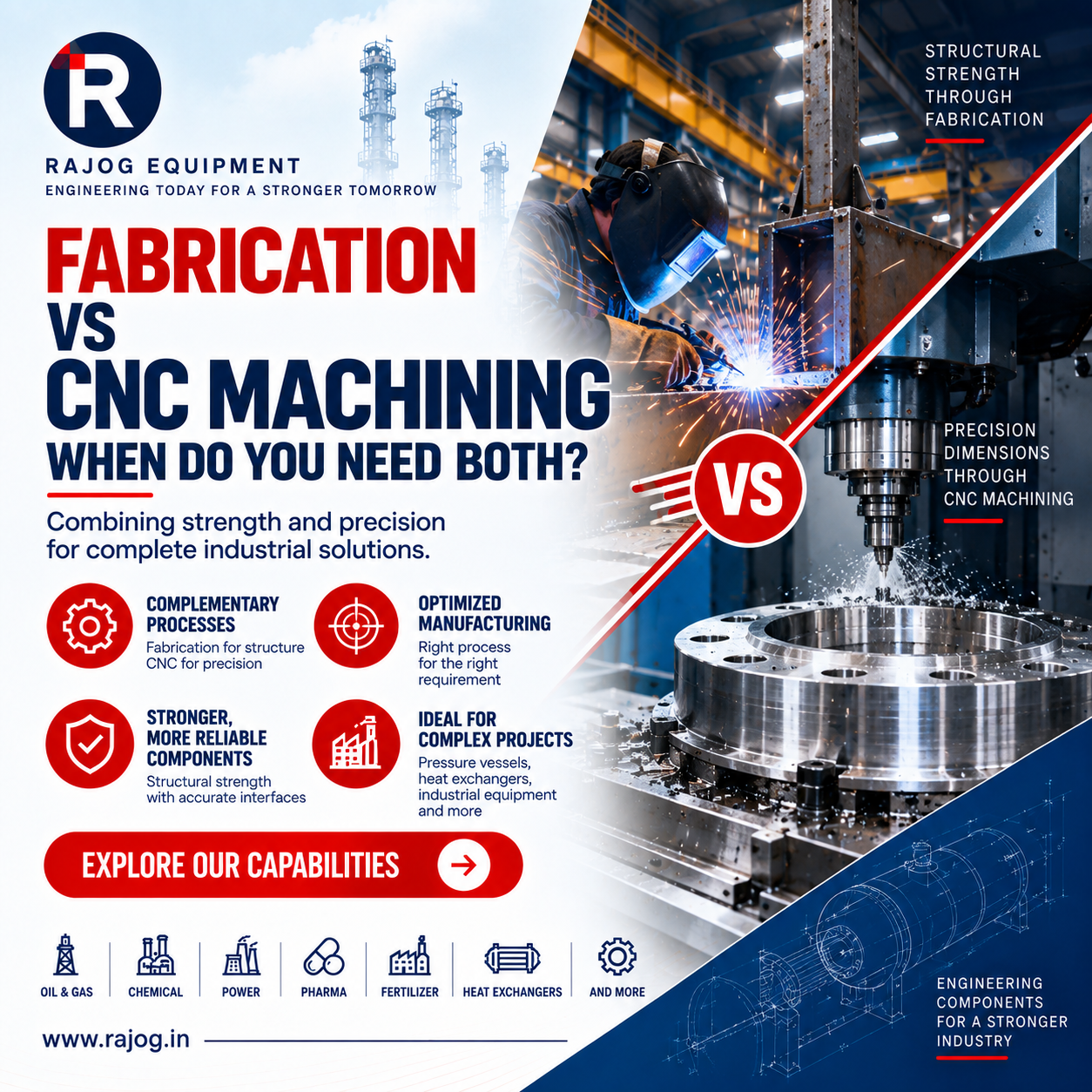
Fabrication creates structures and assemblies, while CNC machining produces precise features and dimensions. Fabrication works by cutting, bending, rolling and welding material into the required shape. CNC machining removes material to achieve exact geometry, tolerances, interfaces and surface finish. Neither process replaces the other in every situation; the best choice depends on design, material, dimensions, tolerances and intended application.
Why Do Some Industrial Projects Need Both?
Many heavy industrial components cannot be completed efficiently through fabrication or machining alone. A fabricated structure may have the correct overall shape but still require accurate machined surfaces, holes, bores or mounting interfaces. Conversely, machining an entire large component from a solid block may involve unnecessary material removal when part of the geometry could be produced through fabrication. Combining fabrication and CNC machining allows manufacturers to use each process where it is most suitable.
When Large Components Need Precision Features
Large fabricated components may require machined faces, accurately positioned holes, mounting surfaces or internal bores. For example, a fabricated industrial assembly may need a machined interface to ensure correct alignment with other equipment. Fabrication creates the main structure, while CNC machining produces the required precision features.
When Pressure Vessels and Tube Sheets Require Both
Pressure vessels and heat-transfer equipment often include formed or fabricated sections that require machining at specific interfaces. Tube sheets may need numerous accurately positioned holes and defined dimensional relationships, while flanges and interfaces can require precise surface finish and alignment. In these cases, fabrication and machining contribute different functions to the finished component.
How Fabrication and CNC Machining Work Together
- Engineering and drawing review to confirm dimensions, materials, tolerances and manufacturing requirements.
- Material preparation and fabrication to cut, form, roll and weld the structure as specified.
- CNC machining to produce required faces, holes, bores and interfaces.
- Inspection and verification to check dimensions, weld quality and acceptance criteria.
- Final assembly or dispatch after all agreed manufacturing and documentation requirements are completed.
Benefits of Combining Both Processes
- Reduced unnecessary material removal by using fabrication for the basic geometry and machining only for precision features.
- Better coordination of manufacturing operations across fabrication, machining and inspection.
- Improved dimensional control for interfaces, holes and mounting points.
- Greater flexibility for complex custom industrial equipment and heavy engineering projects.
- More coordinated quality inspection when requirements are defined early in the production sequence.
Challenges to Consider
Although integration can be useful, fabrication and machining introduce different technical considerations. Welding can cause distortion, fabricated parts may need extra machining allowance, large components require suitable handling and workholding, and tolerance planning must reflect functional requirements. Inspection needs should be defined early so that weld quality, dimensional checks and material traceability are all addressed properly.
How to Choose the Right Manufacturing Partner
- Can the supplier handle the required component size and weight?
- Does the facility have suitable fabrication and machining equipment?
- Can the supplier interpret engineering drawings and tolerances?
- How are welding procedures and inspection requirements managed?
- What dimensional inspection facilities are available?
- Can the supplier coordinate fabrication, machining and finishing?
Common Manufacturing Problems and Solutions
Many industrial manufacturing projects encounter practical issues when a design requires both structural fabrication and precision machining. The key is to identify the critical dimensions early and decide which features should be fabricated and which should be machined. This helps avoid tolerance problems, unnecessary material removal, and rework during final assembly.
Problem 1: Fabricated Components Do Not Meet Required Tolerances
Problem: A fabricated industrial frame or assembly may have the correct overall shape, but welding distortion and dimensional variations can affect the alignment of mounting surfaces, holes and mating components. Answer / Solution: Review the engineering drawing before manufacturing and identify which surfaces require precision machining. Allow sufficient machining material during fabrication, plan the machining sequence, and inspect the finished dimensions against the specified tolerances. Key takeaway: Fabrication creates the structure, while CNC machining corrects specified dimensions and produces precision features where required.
Problem 2: Machining a Large Component from Solid Material Is Inefficient
Problem: Manufacturing a large industrial component entirely from a solid block can require substantial material removal, longer machining operations and additional material handling. Answer / Solution: Where the engineering design permits, fabricate the basic structure from suitable metal plates or sections, then machine only the surfaces, holes, bores and interfaces that require precise dimensions. Key takeaway: Combining fabrication and CNC machining can reduce unnecessary material removal, depending on the design and manufacturing requirements.
Problem 3: Tube Sheet Holes Require Accurate Positioning
Problem: Tube sheets used in heat-transfer equipment may require numerous holes positioned according to an engineering drawing. Inaccurate hole locations or diameters can create assembly difficulties. Answer / Solution: Review the tube sheet drawing, material specifications, hole pattern and dimensional tolerances before production. Use suitable machining and inspection methods to verify hole dimensions and positions against the approved requirements. Key takeaway: Tube sheet fabrication and preparation may be followed by precision drilling or CNC machining, depending on the component specification.
Problem 4: Welding Distortion Affects Machining Accuracy
Problem: Welding can introduce distortion or residual stresses that affect the final geometry of a fabricated component. If machining is planned without considering these effects, rework may be required. Answer / Solution: Plan welding, dimensional checks, any specified stress-relief treatment, and machining allowances as part of the manufacturing sequence. Verify the component's condition before carrying out critical machining operations. Key takeaway: Fabrication, machining and inspection should be planned together rather than treated as unrelated operations.
Which Process Is Right for Your Project?
Choose fabrication when the main objective is to cut, form, roll or join material into a structure. Choose CNC machining when the component requires accurately controlled dimensions, holes, bores, surfaces or profiles. Consider both processes when the component combines a fabricated structure with precision-machined features or interfaces. The engineering drawing, material, component size, tolerance requirements and applicable inspection criteria should guide the final decision.
Final Thoughts
Fabrication and CNC machining serve different but complementary roles in industrial manufacturing. Fabrication creates structures through cutting, forming, rolling and joining, while CNC machining produces specified dimensions and features through controlled material removal. For pressure vessels, tube sheets, heavy industrial assemblies and custom-engineered components, using both processes may be necessary to achieve the required geometry and dimensional accuracy. By planning fabrication and machining together where appropriate, industrial buyers can make better-informed decisions about supplier capability and project execution. For heavy fabrication and machining requirements, explore Rajog Equipment’s manufacturing capabilities.