
Introduction
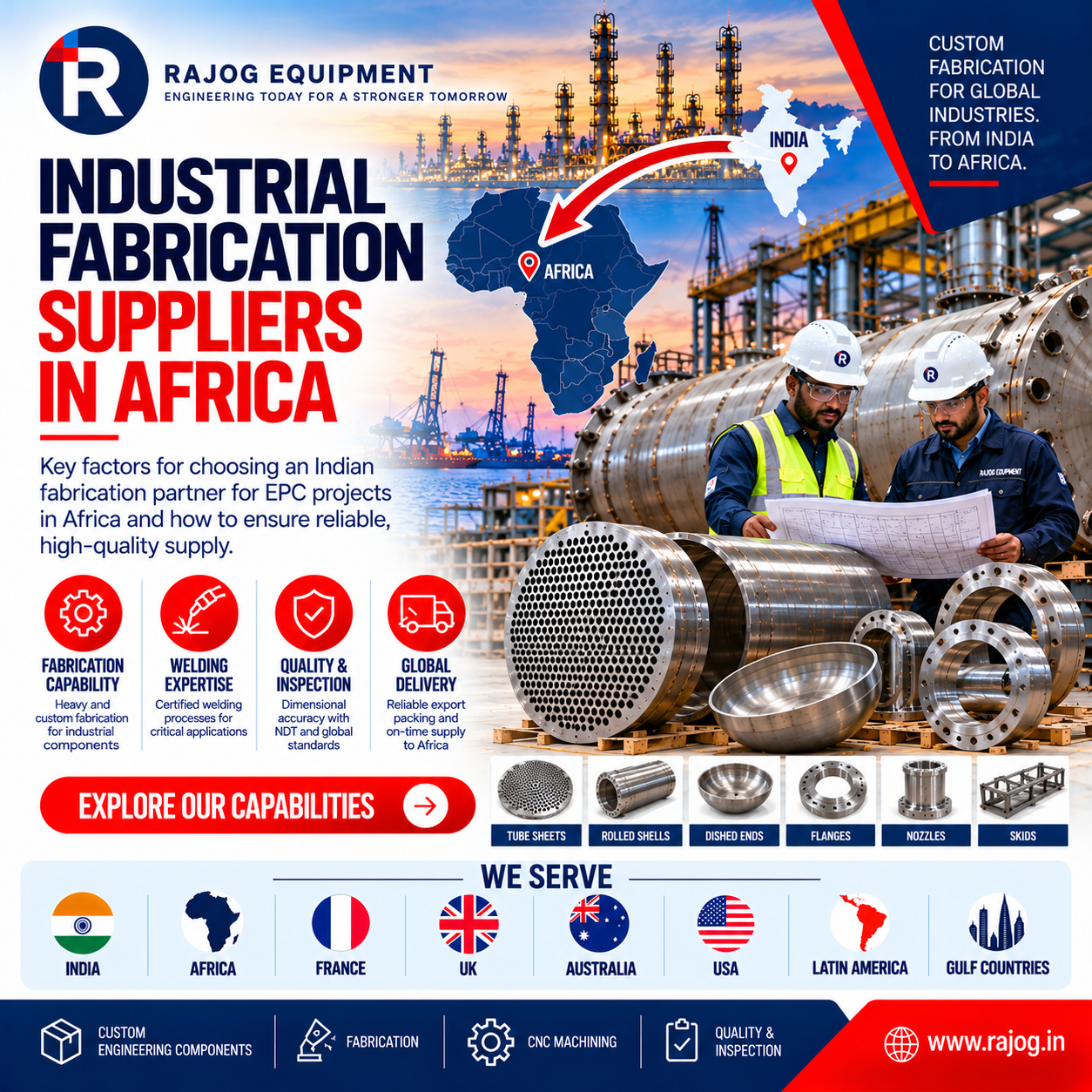
African industrial projects need reliable suppliers for fabricated components, equipment structures, pressure equipment parts, skids, supports and custom engineering assemblies. When local capacity or project requirements lead procurement teams to consider international sourcing, Indian manufacturers can be one option to evaluate. Selecting the right partner calls for a structured assessment of technical capability, quality, capacity, communication and logistics.
What Should an Industrial Buyer Look For?
The supplier should understand project engineering requirements and manufacture to approved specifications. Assess fabrication and welding capability, material control, dimensional accuracy, machining, inspection, documentation, production capacity, delivery planning and export logistics as connected parts of the supplier’s offering.
1. Evaluate Fabrication Infrastructure
Industrial fabrication can involve plate cutting, rolling, forming, fit-up, welding, structural fabrication, assembly and dimensional inspection. Ask for the equipment and capacity relevant to the specific component—such as size limits, plate thickness, forming capacity and handling arrangements—instead of relying on general service descriptions.
2. Confirm Whether Machining Is Available
Some fabricated components need post-fabrication machining of mounting faces, flange surfaces, bores, drilled interfaces or equipment mounting points. If machining is part of the scope, assess machine capacity, workholding and inspection. Coordinating fabrication and machining through a single capable partner may reduce handoffs, but verify the actual process and capacity for each operation.
3. Review Welding and Dimensional Control
Fabrication quality depends on controlled fit-up and welding. Ask how the supplier manages welding sequence, distortion, dimensional checks, weld inspection and post-fabrication machining. Confirm which procedures, records and inspection stages apply to the project specification.
4. Define Quality Documentation
International procurement may require material certificates, welding records, inspection reports, NDT documentation, dimensional reports and a final quality dossier. Agree the exact documents, format, review timing and traceability expectations during project planning. Avoid assuming that a standard package will match the project’s requirements.
5. Assess Capacity and Scalability
A supplier may suit one component but not a larger order or future project. Evaluate shop-floor capacity, crane and machine capacity, workforce, production planning and ability to manage multiple components. Ask how capacity is reserved and how potential schedule constraints will be communicated.
6. Evaluate Communication and Total Cost
International manufacturing requires clear technical discussions across project teams and time zones. Look for timely technical clarification, transparent quotations, production updates, inspection coordination, dispatch information and document status. Compare total procurement cost—including manufacturing, inspection, packaging, freight, customs, handling and delivery risk—not just the quoted manufacturing price.
Supplier Evaluation Scorecard
Compare shortlisted suppliers using consistent questions:
- Fabrication: Can the supplier manufacture the component to the drawing?
- Machining: Can critical surfaces be machined and inspected in scope?
- Quality: How are inspection, traceability and records controlled?
- Capacity: Can the supplier handle the size, weight and order volume?
- Delivery: Is there a realistic schedule and milestone plan?
- Logistics: Can export packing and shipping coordination be managed?