
Introduction
The Gulf region has significant industrial requirements across oil and gas, petrochemicals, power, water treatment, desalination, steel, cement and process industries. GCC companies seeking custom-engineered components may consider India as an international manufacturing source. The key is finding a supplier that can meet technical requirements while maintaining quality, documentation, delivery and logistics control.
What Can GCC Buyers Source?
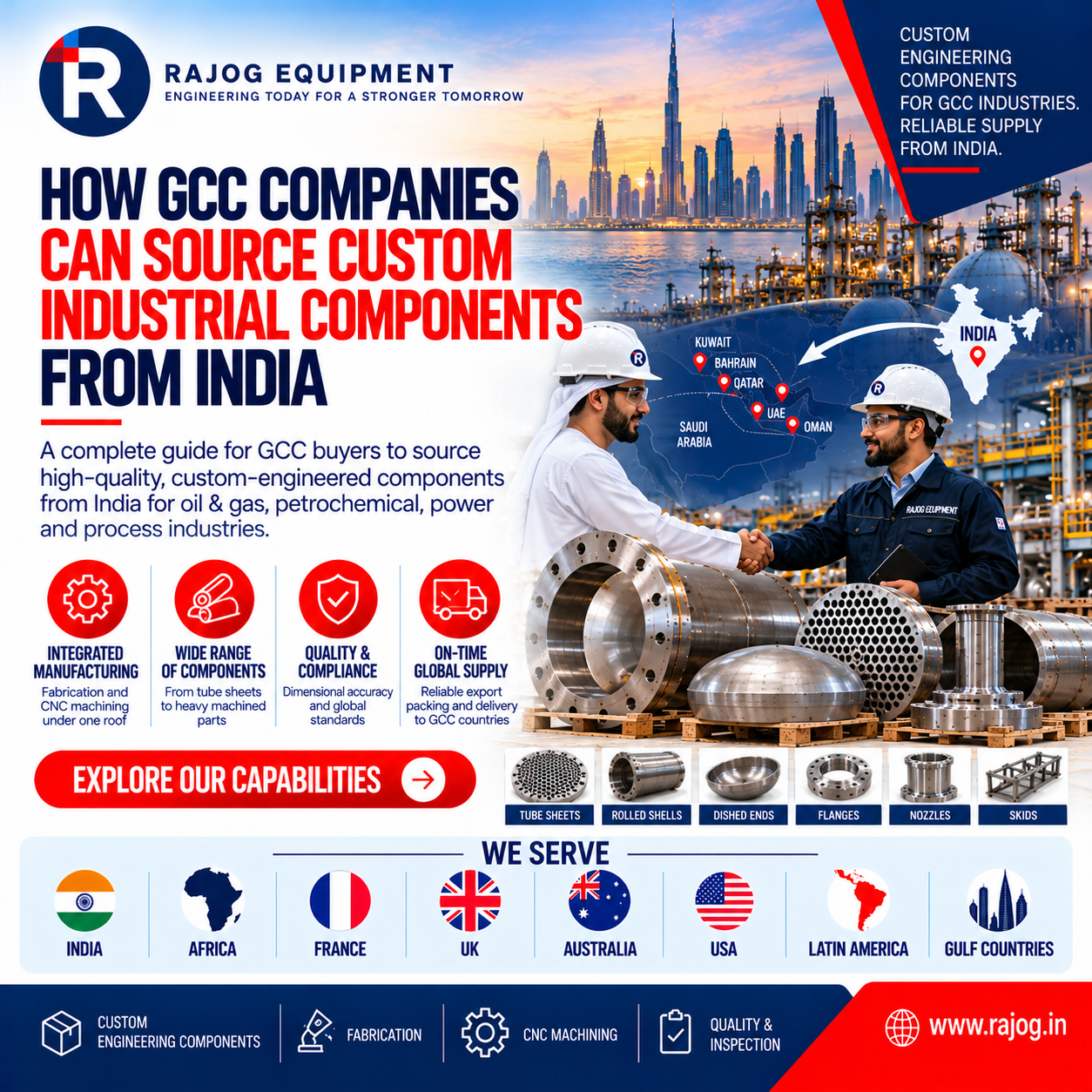
Depending on a manufacturer’s capabilities and the project specification, custom industrial components may include tube sheets, pressure vessel components, rolled shells, dished ends, heavy flanges, nozzles, skids, equipment supports, large machined components and fabricated assemblies. Confirm the scope against the individual supplier’s equipment and experience.
1. Begin With a Complete Drawing Package
The technical drawing is the foundation of procurement. Before requesting quotations, provide the latest approved drawing, material specification, dimensions, tolerances, quantity, inspection and documentation requirements, delivery location and required schedule. State any assumptions or project standards that affect manufacture. A complete RFQ reduces ambiguity and makes supplier quotations easier to compare.
2. Evaluate Manufacturing Capability
Verify that the supplier has suitable fabrication equipment, CNC machining, plate rolling and forming, welding infrastructure, heavy lifting systems and inspection facilities. Check actual component dimensions and weight against the supplier’s machine envelope, shop space and handling capacity.
3. Review Engineering Support
Ask the supplier to review manufacturing implications before production. This can surface machining allowance, welding sequence, distortion risks, accessibility, material preparation and inspection points. Resolve technical clarifications through an approved drawing or documented process before work begins.
4. Set Quality and Traceability Expectations
Quality should be built into the manufacturing plan. Depending on the project, buyers may require material certificates, dimensional reports, NDT records, welding documentation, inspection records and traceability information. List applicable requirements and deliverables in the RFQ and agree when inspections and documents will be submitted.
5. Plan Delivery and Logistics
Discuss the production schedule, inspection dates, packing method, component dimensions and weight, shipping arrangements and delivery terms early. Packaging and transport requirements can affect the manufacturing plan, handling arrangements and overall schedule.
6. Compare Suppliers on Total Value
A lower quotation can be offset by rework, delays, documentation gaps, quality rejection or additional logistics costs. Compare technical compliance, manufacturing capacity, quality controls, delivery plan and total landed cost alongside price. When fabrication and machining can be coordinated through one supplier, buyers may reduce vendor communication, transportation between suppliers, interface problems and scheduling complexity.