
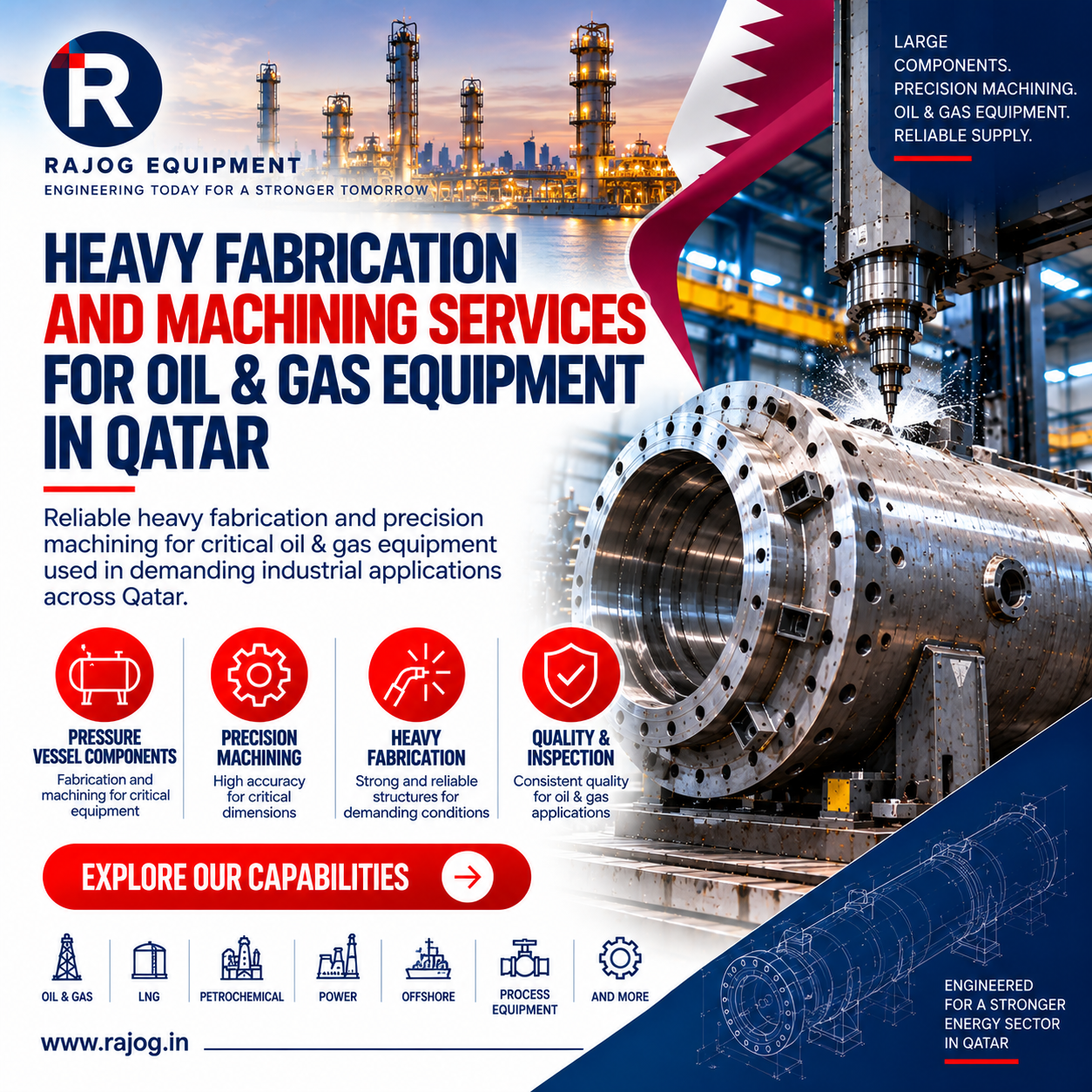
Qatar has a major industrial base built around oil and gas, LNG, petrochemicals, energy, and related processing industries. Equipment used in these sectors often needs to handle demanding operating conditions, large loads, pressure-related requirements, and continuous industrial operation.
This makes the manufacturing of large industrial components a highly controlled process.
Heavy fabrication and precision machining can play an important role in producing structural assemblies, pressure equipment components, machined interfaces, supports, shells, flanges, and other heavy engineering components used across industrial projects.
For companies sourcing equipment and components for Qatar's oil and gas sector, selecting a manufacturing partner with suitable fabrication, machining, inspection, and material-handling capabilities is an important part of project planning.
What Is Heavy Fabrication for Oil & Gas Equipment?
Heavy fabrication involves manufacturing large and complex industrial structures from steel plates, sections, and other engineering materials.
- Heavy steel structures
- Pressure vessel components
- Rolled shells
- Dished ends
- Tube sheets
- Heavy flanges
- Nozzles
- Equipment supports
- Skids
- Custom fabricated assemblies
The exact manufacturing process depends on the equipment design, material, dimensions, applicable specifications, and customer requirements.
For oil and gas applications, fabrication quality and dimensional control are particularly important because components may become part of larger process or equipment systems.
Why Fabrication and Machining Are Both Important
Large industrial components often require a combination of fabrication and precision machining.
Fabrication
Fabrication creates the basic structural shape and assembly.
- Plate cutting
- Forming
- Plate rolling
- Press forming
- Fit-up
- Welding
- Assembly
Machining
Machining is used where specific surfaces or features require controlled dimensions and tolerances.
- Mounting surfaces
- Flanges
- Bores
- Holes
- Reference surfaces
- Precision interfaces
- Machined component faces
Combining these capabilities can help coordinate the manufacturing process from initial fabrication through final machining and inspection.
Key Heavy Fabrication Processes
1. Engineering and Drawing Review
Before manufacturing starts, the drawings and technical requirements should be reviewed carefully.
- Overall dimensions
- Material specifications
- Plate thickness
- Component weight
- Welding requirements
- Machining requirements
- Dimensional tolerances
- Inspection requirements
- Surface finish requirements
Early review helps identify fabrication and machining requirements before production begins.
2. Plate Cutting
Heavy plates are cut according to the required dimensions and component geometry.
- Edge preparation
- Cleaning
- Marking
- Dimensional inspection
- Component identification
Accurate cutting provides a good starting point for subsequent fit-up and fabrication.
3. Plate Rolling and Forming
Oil and gas equipment can include cylindrical or curved components that require controlled forming.
Plate rolling can be used to produce cylindrical shells and other curved sections according to the required geometry.
Press forming may also be used for components that require specific shapes.
The forming process needs to account for material properties, thickness, required geometry, and project specifications.
4. Fit-Up and Welding
After cutting and forming, components are positioned and assembled before welding.
Large fabricated structures require careful fit-up because dimensional errors can affect the final assembly.
Welding can also introduce thermal distortion.
- Welding sequence
- Joint preparation
- Fit-up accuracy
- Heat input
- Dimensional checks
- Applicable welding procedures
CNC Machining for Oil & Gas Equipment
Fabricated components may require additional machining to achieve the required dimensions and surface conditions.
CNC machining can be used for large industrial components such as:
- Heavy flanges
- Tube sheets
- Equipment interfaces
- Mounting surfaces
- Large machined components
- Precision holes
- Bores
- Reference surfaces
For large components, machining capacity is influenced by:
- Component diameter
- Overall dimensions
- Weight
- Required tolerances
- Workholding
- Accessibility
- Machine capacity
Therefore, buyers should confirm that the selected supplier can safely accommodate the complete component.
Common Manufacturing Challenges
Heavy fabrication and machining for oil and gas equipment can involve several challenges.
1. Welding Distortion
Problem
Large welded components can experience dimensional movement due to the heat generated during welding.
Solution
Controlled welding sequences, appropriate fit-up, intermediate dimensional checks, and suitable fabrication planning can help manage distortion.
2. Incorrect Machining Allowance
Problem
If machining requirements are not considered during fabrication, insufficient material may remain for achieving the final dimensions.
Solution
Machining requirements should be identified during drawing review and incorporated into fabrication planning.
3. Dimensional Accuracy
Problem
Large components can be difficult to maintain within required dimensional tolerances throughout fabrication.
Solution
Perform dimensional checks at appropriate stages rather than waiting until final inspection.
4. Heavy Component Handling
Problem
Large oil and gas components can be difficult to lift, rotate, position, and machine.
Solution
Handling requirements should be evaluated before production, including lifting arrangements, crane capacity, shop access, and machining orientation.
5. Coordination Between Fabrication and Machining
Problem
When fabrication and machining are handled without proper coordination, dimensional or scheduling issues can arise.
Solution
Plan the fabrication, machining, inspection, and handling stages together from the beginning.
Quality Control for Oil & Gas Equipment Components
Before Manufacturing
Review:
- Engineering drawings
- Material specifications
- Manufacturing requirements
- Welding requirements
- Machining requirements
- Inspection requirements
During Fabrication
Monitor:
- Material identification
- Cutting dimensions
- Fit-up
- Welding
- Component geometry
- Dimensional accuracy
Before Machining
Check:
- Overall dimensions
- Machining allowance
- Reference points
- Alignment
- Surface condition
After Machining
Verify:
- Critical dimensions
- Holes and bores
- Machined surfaces
- Required tolerances
- Final component geometry
Inspection requirements should always follow the applicable project specifications and customer requirements.
Illustrative Case Study: Oil & Gas Equipment Component
The following is an illustrative manufacturing example and does not represent a specific Rajog customer project.
Consider a large fabricated component intended for an oil and gas processing application in Qatar.
The component requires heavy plate fabrication followed by precision machining of critical interfaces.
A possible manufacturing workflow would be:
Stage 1 – Engineering Review
The drawings, material requirements, dimensions, tolerances, machining requirements, and inspection points are reviewed.
Stage 2 – Material Preparation
Required plates are prepared according to the project specifications.
Stage 3 – Cutting and Forming
The plates are cut and, where required, rolled or formed into the specified geometry.
Stage 4 – Fit-Up and Welding
The fabricated sections are positioned and welded using a controlled sequence.
Stage 5 – Fabrication Inspection
The component is inspected for dimensions, geometry, alignment, and other specified requirements.
Stage 6 – CNC Machining
Critical surfaces, holes, bores, or interfaces are machined according to the engineering requirements.
Stage 7 – Final Inspection
The finished component undergoes dimensional and quality checks before being prepared for delivery.
This example demonstrates how fabrication and machining can work together for large industrial components.
Applications in Qatar's Oil & Gas Industry
Oil & Gas Processing
Large fabricated and machined components can form part of processing equipment and supporting systems.
LNG and Gas Infrastructure
Large industrial components may be required for equipment associated with gas processing and related infrastructure.
Petrochemical Facilities
Heavy engineering components can be used in equipment and structural systems supporting petrochemical operations.
Energy Projects
Industrial equipment and supporting structures often require heavy fabrication and precision manufacturing.
Water and Desalination
Qatar's industrial infrastructure also includes water treatment and desalination applications where large fabricated components can be required.
The exact component requirements depend on the project design and applicable specifications.
How to Choose a Heavy Fabrication and Machining Supplier
For Qatar-based oil and gas projects, buyers should evaluate several technical and operational factors.
Fabrication Capacity
Check whether the manufacturer can handle the required:
- Component dimensions
- Plate thickness
- Component weight
- Fabrication complexity
Machining Capability
Confirm whether the supplier can accommodate the required component size, weight, machining operations, and tolerances.
Welding Capability
Evaluate welding procedures, fabrication experience, inspection practices, and project-specific requirements.
Material Handling
Large industrial components require suitable lifting and handling infrastructure.
Inspection Capability
Ask how dimensional inspection and quality verification are performed throughout manufacturing.
Engineering Support
A supplier capable of reviewing drawings and identifying manufacturing concerns early can help reduce production risks.
Documentation
Confirm the documentation required by the project, including material and inspection records where applicable.
Why Consider an Integrated Manufacturing Partner?
Using a supplier capable of coordinating fabrication and machining can simplify project execution.
An integrated approach can help coordinate:
Engineering Review → Material Preparation → Fabrication → Welding → Inspection → CNC Machining → Final Inspection
Potential advantages include:
- Better process coordination
- Reduced communication gaps
- Easier project management
- Better planning of machining allowances
- Improved dimensional control
- Simplified inspection coordination
For projects requiring heavy fabrication, precision machining, and large industrial components, Rajog Equipment's manufacturing capabilities provide a useful reference for understanding an integrated heavy-engineering manufacturing approach.
What Should Buyers Include in an RFQ?
A detailed RFQ helps the manufacturer evaluate the project properly.
- Engineering drawings
- Material grade
- Plate thickness
- Component dimensions
- Approximate weight
- Quantity
- Welding requirements
- Machining requirements
- Dimensional tolerances
- Inspection requirements
- Surface finish requirements
- Applicable project standards
- Delivery location
- Required delivery schedule
Providing complete technical information can make supplier evaluation and quotation more accurate.
Heavy Fabrication vs Precision Machining
| Requirement | Heavy Fabrication | CNC Machining |
|---|---|---|
| Plate cutting | ✓ | — |
| Plate rolling | ✓ | — |
| Press forming | ✓ | — |
| Fit-up | ✓ | — |
| Welding | ✓ | — |
| Structural assembly | ✓ | — |
| Precision holes | — | ✓ |
| Bores | — | ✓ |
| Precision mounting surfaces | — | ✓ |
| Reference surfaces | — | ✓ |
For many oil and gas components, both manufacturing disciplines may be required.
Final Thoughts
Heavy fabrication and machining are important manufacturing capabilities for large industrial components used in demanding oil and gas applications.
For projects in Qatar, the right manufacturing approach depends on the component design, material, dimensions, tolerances, applicable specifications, inspection requirements, and project logistics.
A capable manufacturing partner should be able to demonstrate appropriate fabrication capacity, machining capability, welding practices, inspection systems, material handling infrastructure, and engineering support.
When fabrication and CNC machining are properly coordinated, manufacturers can manage the complete manufacturing workflow more effectively—from raw material preparation through final inspection.
For industrial buyers, evaluating technical capability and quality processes alongside cost can help create a more reliable sourcing decision.