
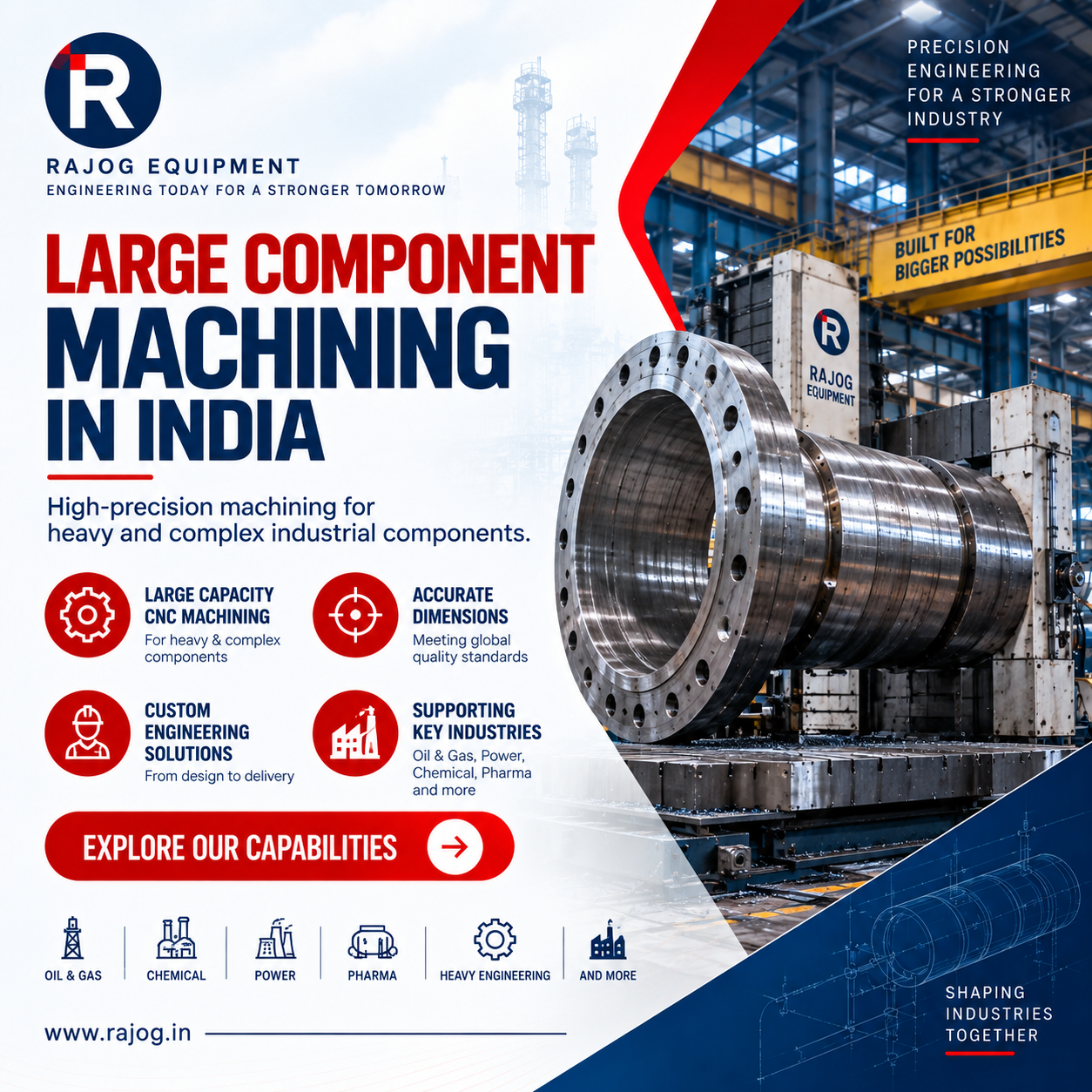
What Is Large Component Machining?
Large component machining refers to the machining of oversized, heavy, or geometrically complex industrial components that cannot be efficiently processed using conventional small- or medium-sized machine tools. These components can involve substantial diameter, length, weight, material thickness, machining depth, geometric complexity and dimensional accuracy requirements. Depending on the component design, machining may involve turning, boring, drilling, milling, facing, threading, grooving or other specialized operations. The objective is to achieve the required dimensions, tolerances, surface finish and geometric accuracy while safely handling the component throughout the manufacturing process.
Why Large Component Machining Is Important for Industrial Manufacturing
Many heavy engineering projects involve components that are too large or heavy for standard machining facilities. A large tube sheet may require extensive drilling and machining operations. A pressure vessel component may require accurate preparation of openings and mating surfaces. Large shafts and flanges may require controlled turning and boring operations. In such applications, machining accuracy can directly influence the final assembly. A capable large component machining partner can help manufacturers achieve accurate component dimensions, consistent machining quality, better assembly compatibility, controlled surface finish, reduced rework, improved manufacturing efficiency and better integration between fabrication and machining.
Key Capabilities Required for Large Component Machining
Not every machine shop is equipped to handle large and heavy components. Buyers should evaluate the complete manufacturing infrastructure before selecting a supplier. This includes machine work envelope, material handling, CNC capability, drilling capacity, machining quality systems and technical experience.
1. Large Machine Work Envelope
- Maximum component diameter
- Maximum component length
- Maximum component weight
- Table size
- Turning capacity
- Boring capacity
- Drilling depth
- Milling envelope
- Tool capacity
2. Heavy Material Handling Capability
Machining a large component requires more than a suitable machine tool. The component must also be safely moved, positioned, loaded, unloaded and supported throughout the manufacturing process. Heavy engineering facilities may therefore require EOT cranes, heavy-duty lifting systems, suitable rigging equipment, component positioning systems, adequate shop-floor space and safe loading and unloading areas. Material-handling capacity becomes especially important when components weigh several tonnes. A mismatch between machining capacity and lifting capacity can create unnecessary handling limitations even when the machine itself is technically suitable.
3. CNC Machining Capability
CNC technology provides controlled and repeatable machining operations for complex industrial components. Depending on the component, CNC machining can support turning, milling, drilling, boring, facing, threading, grooving and profile machining. For large components, CNC programming and process planning are essential because machining sequences need to account for component rigidity, workholding, material behavior, tool selection and dimensional control.
4. Deep-Hole Drilling
Certain industrial components require deep and accurately positioned holes. Deep-hole drilling can be relevant for components such as tube sheets, hydraulic components, heat-transfer equipment and other engineered parts. The process requires careful control of hole diameter, depth, position, straightness, spacing, tool alignment and chip removal. For components with a large number of drilled holes, consistency across the entire component is particularly important.
5. Large-Diameter Turning and Boring
Large circular components often require turning, boring and facing operations. These processes may be required for large flanges, rings, shafts, tube sheets, pressure vessel components, bearing housings and industrial machine components. Large vertical turning and boring equipment can be particularly useful when components have substantial diameters or weights. The machining process should maintain dimensional accuracy while accounting for component weight, workholding and potential deformation.
Materials Commonly Used in Large Component Machining
- Carbon steel
- Stainless steel
- Alloy steel
- Special engineering materials selected for pressure, temperature, corrosion or mechanical requirements
Applications of Large Component Machining
- Oil and gas
- Power generation
- Chemical and process industries
- Heat transfer equipment
- Desalination and water treatment
- Steel and cement industries
- Fertilizer and heavy chemical industries
Quality Control in Large Component Machining
Quality control is one of the most important aspects of large component manufacturing. Because large components can involve significant material costs and long machining cycles, detecting dimensional problems late in production can result in substantial rework. A structured inspection process may include dimensional inspection, diameter measurement, length measurement, hole position verification, surface finish inspection, flatness checks, concentricity checks and final inspection documentation. Buyers should communicate inspection requirements before manufacturing begins so that the supplier can incorporate them into the machining and quality plan.
Importance of Drawings and Engineering Data
Accurate engineering documentation is essential for large component machining. A supplier normally needs component drawings, material grade, dimensions, tolerances, surface finish requirements, hole patterns, machining allowances, welding allowances where applicable, applicable standards and inspection requirements. Clear drawings reduce ambiguity and help the manufacturing team develop an appropriate machining process. For custom components, buyers should also clarify whether the supplier is expected to manufacture strictly according to supplied drawings or provide engineering support as part of the project.
Fabrication and Machining Integration
Many large industrial components are fabricated before they are machined. For example, a large fabricated structure may require welding, stress management, dimensional correction and machining before final assembly. When fabrication and machining are handled through an integrated manufacturing process, coordination between the two stages becomes easier. This can help with manufacturing planning, machining allowances, weld distortion management, dimensional correction, material movement, inspection coordination and final assembly preparation.
How to Choose a Large Component Machining Partner in India
- Verify actual machine capacity
- Review relevant manufacturing experience
- Evaluate inspection infrastructure
- Check material handling infrastructure
- Understand production planning
- Consider integrated services
What Should Be Included in an RFQ?
- Component name, quantity and overall dimensions
- Material grade, condition and certificate requirements
- Machining operations, tolerances and surface finish
- Hole and thread specifications
- Inspection requirements, applicable standards and documentation
- Delivery location, date and packaging expectations
Benefits of Working With an Experienced Large Component Machining Partner
- Better dimensional control
- Reduced rework
- Improved manufacturing coordination
- Better material handling
- Consistent quality
- Project support from fabrication to delivery
Conclusion
Large component machining in India plays an important role in the manufacturing of heavy industrial equipment and engineered components. The right manufacturing partner should have more than large CNC machines. Buyers should evaluate machine capacity, material-handling infrastructure, machining processes, deep-hole drilling capability, quality control, engineering support, fabrication integration and delivery planning. For industries such as oil and gas, power, chemical processing, desalination, heat transfer, fertilizers, steel, cement and heavy engineering, selecting a capable machining partner can contribute to more efficient manufacturing and reliable component quality. When requesting quotations, providing complete drawings, material specifications, machining requirements, inspection standards and delivery expectations can make the procurement process more efficient and transparent. Ultimately, the right large component machining partner should be able to combine machining capacity, engineering knowledge, quality control, material handling and manufacturing coordination to meet the requirements of demanding industrial projects. For heavy fabrication and machining requirements, explore Rajog Equipment’s manufacturing capabilities.