
Introduction
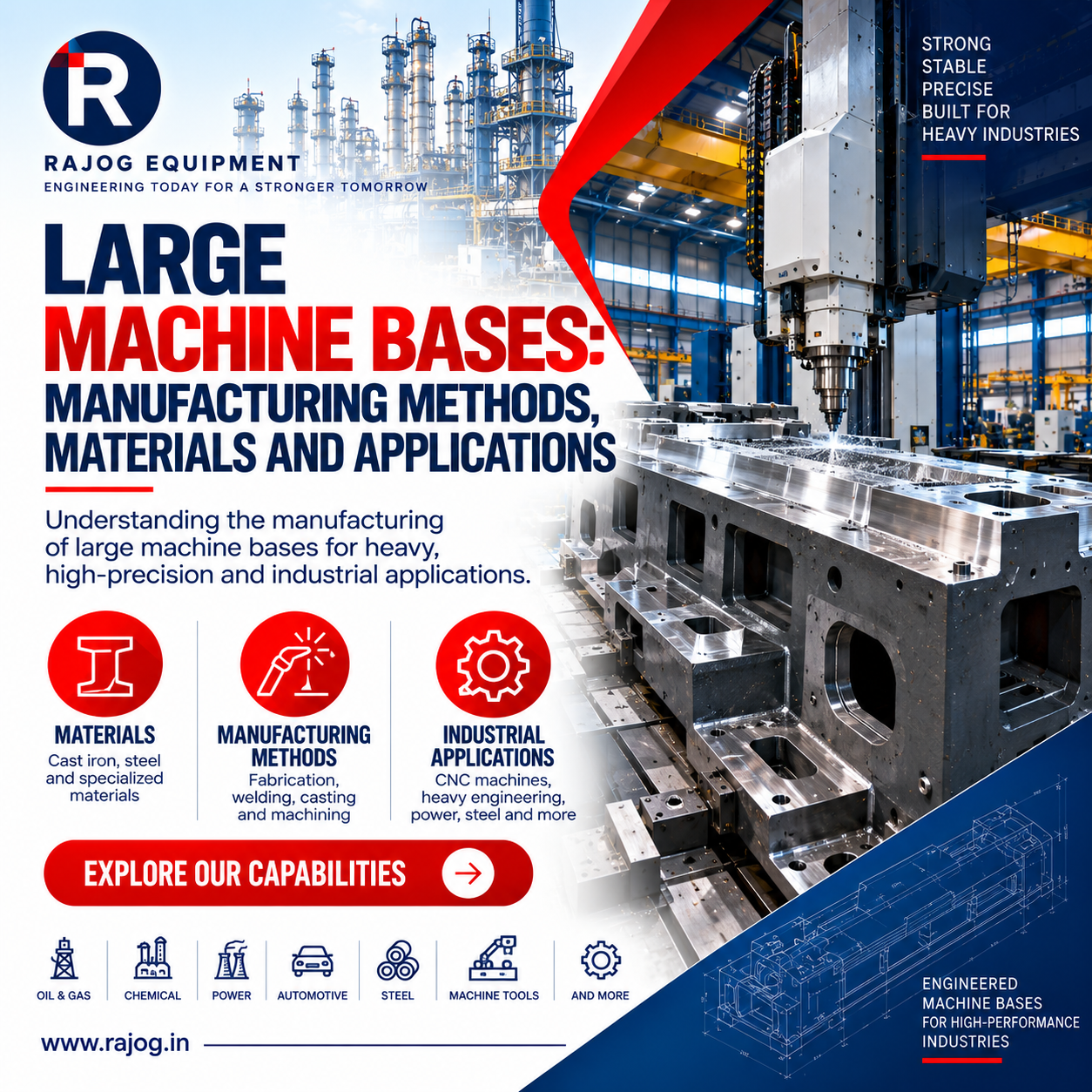
Large machine bases are critical structural components used to support heavy machinery and maintain stability, alignment and dimensional accuracy during operation. Unlike simple support structures, a machine base must be designed and manufactured to withstand heavy loads, vibration, machining forces, thermal effects and long-term operating conditions. They are used in heavy engineering, CNC machinery, machine tools, automation, power generation, steel, automotive and industrial manufacturing. For large and complex machines, base quality can directly influence performance by providing a stable foundation for mounting critical components and maintaining alignment.
What Is a Large Machine Base?
A large machine base is a heavy structural component designed to support and position one or more machine assemblies. Depending on the design, it may include mounting surfaces, machined reference faces, bolt holes, slots, guideways, bearing mounting areas, structural ribs, reinforcement sections and precision-machined interfaces. It may be manufactured as a fabricated structure, casting, welded assembly, or a combination of fabrication and machining. Engineering requirements are determined by the machine load, operating forces, dimensions, mounting arrangement and operating environment.
Why Are Large Machine Bases Important?
- Structural stability: provide a rigid support capable of carrying static and dynamic machine loads.
- Vibration control: help provide the structural stability needed for machining and rotating equipment.
- Component alignment: machined reference surfaces and mounting points help position machine components correctly.
- Load distribution: distribute equipment loads across the supporting structure or foundation.
- Long-term accuracy: dimensional stability and stress management can influence performance over extended operation.
Materials Used for Large Machine Bases
Material selection depends on the machine design, load requirements, fabrication method and required dimensional stability. Cast iron is traditionally used for machine structures because of its rigidity and vibration-damping characteristics. Structural steel is widely used for large fabricated bases and can incorporate plates, structural sections, stiffeners, ribs and mounting plates. Welded steel assemblies are useful when a base is too large or complex for conventional casting. Other specialized materials may be considered for weight, stiffness, corrosion resistance, temperature or performance requirements. Material selection should follow the engineering requirements rather than simply choosing the strongest available material.
Fabrication and Welding
For very large bases, fabrication can be a practical manufacturing approach. A process may include material preparation, plate cutting, component forming, fit-up, welding, stress management, machining and inspection. Large plates are assembled to create the required structure, with internal ribs and stiffeners added where the design requires greater rigidity.
CNC Machining
After fabrication, critical surfaces may require precision machining. This can include mounting faces, reference surfaces, bolt holes, bores, slots, guide surfaces, bearing seats and equipment interfaces. The machining plan needs to account for component size and weight, feature accessibility and dimensional tolerances.
Casting
Casting can be suitable when the component geometry and production requirements allow it. A casting can provide an integrated structure with ribs and complex geometry, but large cast components require suitable foundry capabilities, tooling, material control, heat treatment and machining infrastructure.
Fabrication Combined with Machining
For large industrial applications, combining fabrication and machining can provide a practical route: the fabricated structure provides the required overall geometry and strength, while machining establishes precision surfaces and interfaces. This approach is particularly useful when the base is too large or complex for conventional manufacturing methods.
Stress Relief and Machining Allowance
Welding can introduce residual stresses into fabricated structures. For machine bases requiring precision machining, stress management may be an important manufacturing step; the appropriate method depends on the material, design, welding procedure and engineering requirements. Adequate machining allowance should also be planned during fabrication. If insufficient material is left for final machining, achieving the required dimensions can become difficult.
Welding Sequence and Reference Surfaces
The welding sequence can influence distortion in large welded bases. Controlled welding procedures and fabrication planning can help maintain dimensional stability. Carefully defined datum and reference surfaces provide the basis for machining and positioning other machine components.
Dimensional Inspection
- Overall dimensions
- Flatness and parallelism
- Hole positions and mounting locations
- Alignment
- Critical machined surfaces
Applications of Large Machine Bases
- CNC and machine tools: structural foundations for large CNC machines, boring machines, machining centres and other machine tools.
- Heavy engineering: support for heavy engineering equipment and large fabricated assemblies.
- Automotive manufacturing: bases for production machinery, assembly systems and specialized equipment.
- Steel industry: robust structural support for large processing and production equipment.
- Power generation: heavy-duty bases and support structures for manufacturing and power-generation equipment.
- Automation and industrial machinery: rigid, accurately machined bases that help maintain positioning and repeatability.
Large Machine Bases vs. Standard Machine Bases
- Component size: very large, often requiring a larger manufacturing work envelope.
- Weight: high, with corresponding material-handling requirements.
- Fabrication: often completed in multiple stages.
- Welding: distortion requires greater consideration.
- Machining: requires suitable large-capacity equipment.
- Inspection: dimensional checks may be more extensive.
- Transportation: lifting and delivery need detailed planning.
- Manufacturing, machining, handling, inspection and transportation need to be planned together as size increases.
Typical Manufacturing Workflow
- Engineering and drawing review
- Material selection and preparation
- Plate cutting
- Forming and component preparation
- Fit-up and welding
- Dimensional inspection
- Stress management, if required
- CNC machining
- Final inspection
- Surface treatment, finishing and dispatch
Common Manufacturing Challenges
- Welding distortion: heat input can distort large structures. Plan the welding sequence, fixturing, controlled fabrication and dimensional inspection.
- Difficult machining: specialized equipment may be needed to accommodate the work envelope and component load. Confirm machining capacity before production.
- Handling and movement: bases may weigh several tonnes. Consider crane capacity, lifting points, shop-floor access and transportation during planning.
- Dimensional accuracy: establish clear datums, inspection stages, machining sequences and measurement procedures for large components.
How to Choose a Large Machine Base Manufacturer
- Manufacturing capacity: confirm the supplier can handle the required dimensions and weight.
- Fabrication capability: check cutting, forming, welding and assembly infrastructure.
- Machining capability: verify the work envelope and ability to machine surfaces and interfaces to specified tolerances.
- Material handling: confirm suitable cranes and lifting systems are available.
- Quality control: review dimensional inspection and documentation processes.
- Engineering support: assess the supplier's ability to review drawings and identify manufacturing considerations before production.
- Project experience: ask about experience with similar large and complex components.
What Should Be Included in an RFQ?
- Engineering drawing and material specification
- Overall dimensions and approximate weight
- Required tolerances and machining requirements
- Welding and inspection requirements
- Surface finish requirements
- Quantity, delivery location and required delivery schedule
Final Thoughts
Large machine bases are more than heavy support structures: they influence machine rigidity, alignment, vibration behaviour, dimensional stability and overall equipment performance. Successful manufacturing can require coordinated fabrication, welding, stress management, precision machining, inspection and heavy material handling. Selecting a manufacturer with suitable equipment, engineering capability, machining capacity and quality-control processes can reduce manufacturing risks and improve finished-base reliability. Buyers looking for an integrated manufacturing partner can review Rajog Equipment’s manufacturing capabilities.