
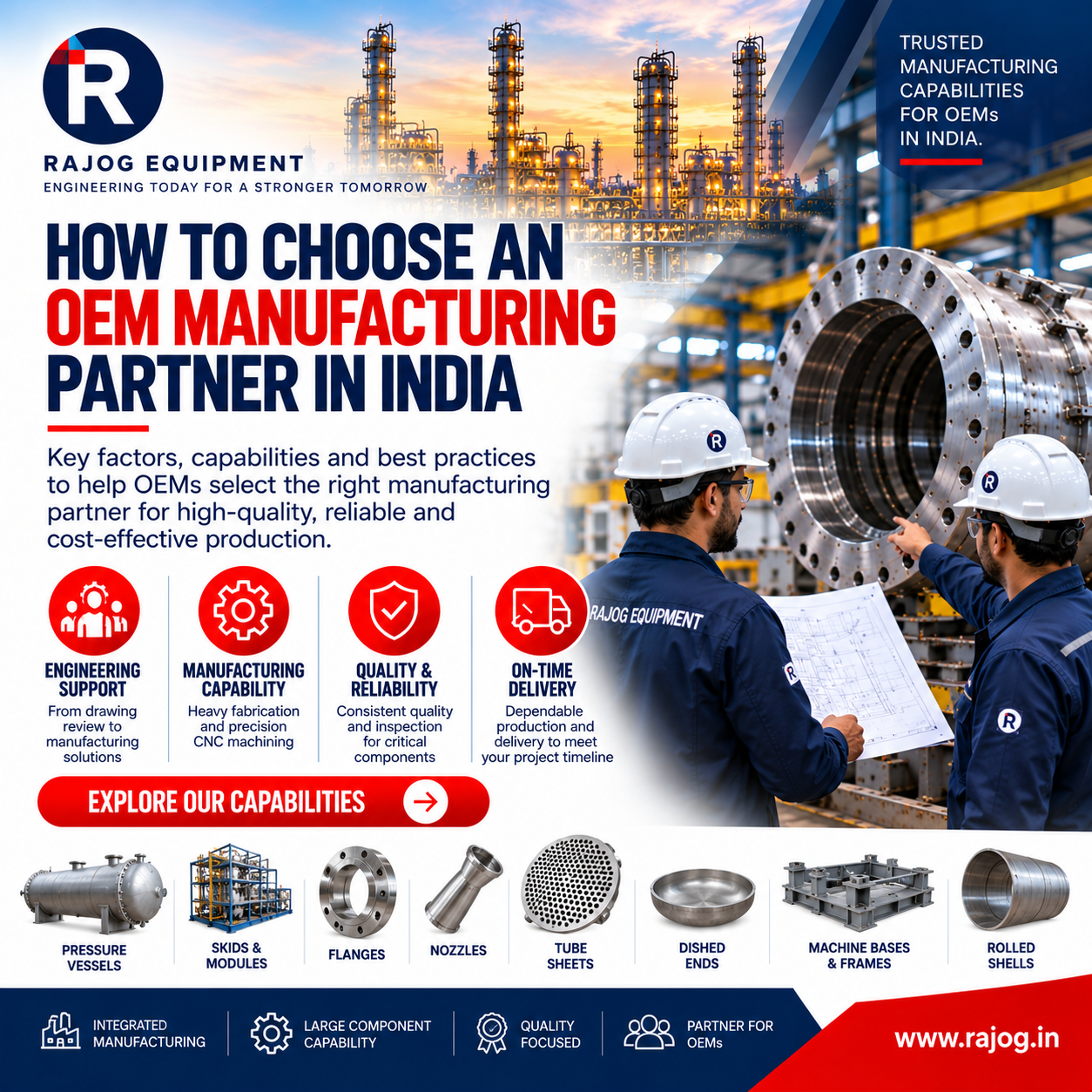
Introduction
Choosing the right OEM manufacturing partner in India can directly influence product quality, production timelines, manufacturing costs, and long-term supply-chain reliability. For industrial OEMs, the decision goes beyond comparing quotations. A capable manufacturing partner should understand engineering requirements, manage complex manufacturing processes, maintain quality, and deliver consistently.
India has a broad manufacturing ecosystem covering fabrication, machining, engineering components, industrial equipment, and custom manufacturing. However, not every supplier is equipped to handle large, complex, or precision-critical OEM requirements.
This guide explains the key factors OEMs should evaluate before selecting a manufacturing partner in India.
What Is an OEM Manufacturing Partner?
An OEM manufacturing partner is a company that manufactures components, assemblies, or equipment according to an OEM's drawings, specifications, quality requirements, and production needs. Depending on the project, an OEM manufacturing partner may support:
- Custom component manufacturing
- Heavy fabrication
- CNC machining
- Welding and assembly
- Precision machining
- Industrial equipment components
- Inspection and quality control
- Material traceability
- Manufacturing documentation
The right partner should work as an extension of the OEM's supply chain rather than simply performing an individual manufacturing operation.
Why Choosing the Right OEM Manufacturing Partner Matters
A manufacturing supplier can have a direct impact on the overall success of an OEM project. The wrong supplier may result in:
- Manufacturing delays
- Dimensional inaccuracies
- Rework and additional machining
- Quality issues
- Incomplete documentation
- Production bottlenecks
- Higher transportation and coordination costs
- Delayed customer deliveries
A reliable manufacturing partner can help OEMs create a more predictable production process while reducing unnecessary supplier coordination.
10 Factors to Consider When Choosing an OEM Manufacturing Partner in India
1. Manufacturing Capability
The first step is to determine whether the supplier has the manufacturing capabilities required for your product. Depending on the component, this may include:
- Heavy fabrication
- Plate cutting
- Plate rolling
- Press forming
- Welding
- CNC machining
- VTL machining
- Deep-hole drilling
- Assembly
- Dimensional inspection
Do not evaluate capability only by the list of machines available. Consider whether those machines and processes are suitable for your actual component size, weight, tolerance, and production requirements.
2. Experience With Similar Components
Experience with similar components can reduce manufacturing risk. For example, an industrial OEM may require components such as:
- Tube sheets
- Pressure vessel components
- Rolled shells
- Dished ends
- Heavy flanges
- Nozzles
- Skids
- Equipment supports
- Heavy machined components
- Machine bases and frames
Ask potential suppliers whether they have experience manufacturing components with comparable size, material, complexity, and inspection requirements.
3. Engineering and Drawing Review
A good manufacturing partner should review the technical requirements before production begins. Important areas include:
- Drawing revisions
- Material specifications
- Dimensional tolerances
- Machining allowances
- Welding requirements
- Surface finish
- Inspection requirements
- Manufacturing sequence
Early engineering review can identify potential production challenges before they become expensive problems. The supplier should also communicate any manufacturing concern to the OEM instead of making unapproved design changes.
4. CNC Machining Capability
For precision components, machining capability is a critical consideration. OEMs should evaluate:
- Machine capacity
- Component size limitations
- Component weight limitations
- Machining tolerances
- Workholding capability
- Large-bore machining
- Flange machining
- Hole patterns
- Reference surface machining
- Dimensional inspection
For large industrial components, the supplier's ability to safely handle and position the component can be just as important as the machining machine itself.
5. Fabrication and Welding Capability
Many industrial OEM components require fabrication before machining. A capable supplier should have a controlled approach to:
Material Preparation → Cutting → Fit-Up → Welding → Inspection → Machining
Large welded structures can experience distortion and dimensional movement during fabrication. Therefore, fabrication planning, welding sequence, fixtures, dimensional checks, and appropriate stress-management practices should be considered where applicable.
6. Quality Control and Inspection
Quality should be controlled throughout manufacturing rather than checked only at the end. A typical quality flow may include:
Material Verification → In-Process Inspection → Fabrication Inspection → Machining Inspection → Final Dimensional Inspection
Depending on project requirements, OEMs may also require specific inspection or testing activities. Before selecting a supplier, clarify:
- Inspection procedures
- Measuring equipment
- Dimensional inspection capability
- Material traceability
- NDT requirements where applicable
- Quality documentation
- Final inspection process
7. Production Capacity and Infrastructure
A supplier may have excellent technical skills but still be unsuitable if it cannot handle the required production volume or component size. Evaluate:
- Factory infrastructure
- Machine capacity
- Shop-floor space
- Crane and lifting capacity
- Material-handling systems
- Fabrication area
- Machining area
- Workforce capability
- Production planning
For heavy engineering components, infrastructure can significantly influence project execution.
8. Delivery Reliability
OEM production schedules are often dependent on multiple suppliers. A delayed component can affect assembly, testing, commissioning, and final customer delivery. Ask potential manufacturing partners about:
- Production planning
- Manufacturing milestones
- Lead-time estimation
- Progress communication
- Inspection scheduling
- Dispatch planning
A supplier that communicates potential delays early is generally easier to manage than one that provides updates only after a deadline is missed.
9. Documentation and Traceability
Documentation is an important part of industrial manufacturing. Depending on the project, the OEM may require:
- Material certificates
- Inspection reports
- Dimensional reports
- Welding records
- NDT reports
- Traceability records
- Quality certificates
- Final documentation packages
Documentation requirements should be discussed during the RFQ stage rather than after manufacturing is completed.
10. Communication and Project Management
Technical capability alone does not guarantee a successful OEM relationship. A reliable manufacturing partner should maintain clear communication between:
OEM Engineering → Supplier Engineering → Production → Quality → Procurement → Dispatch
Good communication helps resolve technical questions faster and reduces misunderstandings related to drawings, revisions, inspection, and delivery schedules.
Common Problems When Selecting the Wrong Manufacturing Partner
Problem 1: Low Quotation but High Rework
Problem 2: Fabrication and Machining Are Not Properly Coordinated
Problem 3: Manufacturing Delays
Problem 4: Incomplete Documentation
Problem 5: Supplier Cannot Scale
A Practical OEM Supplier Evaluation Framework
OEM procurement teams can score potential manufacturing partners across these categories:
- Manufacturing — Processes, machine capacity and component size.
- Engineering — Drawing review and manufacturing support.
- Quality — Inspection, traceability and documentation.
- Infrastructure — Factory, cranes, handling and shop-floor capacity.
- Delivery — Lead time, planning and communication.
- Experience — Similar components and industries.
- Scalability — Ability to handle repeat or higher-volume requirements.
- Commercial — Pricing, logistics and overall project value.
This approach helps OEMs compare suppliers based on the complete manufacturing requirement rather than price alone.
What Should You Include in an OEM RFQ?
A detailed RFQ helps suppliers understand the project accurately and provide a more reliable quotation.
Technical Information
Include:
- Latest drawing revision
- 3D model where applicable
- Material specification
- Component dimensions
- Component weight
- Tolerances
- Surface-finish requirements
- Welding requirements
- Machining requirements
Quality Requirements
Include:
- Inspection requirements
- Testing requirements
- NDT requirements where applicable
- Material traceability requirements
- Documentation requirements
Commercial Requirements
Include:
- Required quantity
- Target delivery date
- Delivery location
- Packaging requirements
- Inspection stages
- Project milestones
The more complete the RFQ, the easier it becomes for the supplier to understand the actual manufacturing scope.
Fabrication and Machining Under One Manufacturing Partner
For complex industrial components, an integrated manufacturing approach can provide operational advantages. Instead of coordinating separate vendors for fabrication and machining, OEMs can work with a supplier capable of managing multiple stages. A typical process can be:
Engineering Review → Material Procurement & Verification → Fabrication → Welding & Inspection → CNC Machining → Dimensional Inspection → Final Quality Review → Documentation & Dispatch
This can reduce unnecessary transportation, communication gaps, and coordination between multiple suppliers.
Illustrative Example: Selecting a Supplier for a Large Industrial Component
Consider an OEM requiring a large fabricated component with several precision-machined interfaces. Instead of selecting a supplier solely based on quotation, the OEM evaluates:
- Component size and weight capability
- Fabrication infrastructure
- Welding and inspection processes
- CNC machining capacity
- Material-handling capability
- Dimensional inspection
- Documentation
- Production schedule
- Previous experience with similar components
- Communication and project management
The selected supplier can then develop a manufacturing sequence covering fabrication, inspection, machining, final inspection, and dispatch. This is an illustrative example and does not represent a specific customer project.
Why Indian OEM Manufacturing Partners Can Be Valuable
India has a broad industrial manufacturing ecosystem covering engineering, fabrication, machining, industrial equipment, and custom component manufacturing. For international and domestic OEMs, the right Indian manufacturing partner can support customized production requirements while providing access to established engineering and manufacturing capabilities. However, the supplier should always be evaluated based on the specific technical requirements of the project, rather than assuming that every manufacturer has the same capabilities.
What Makes a Long-Term OEM Manufacturing Partner?
A long-term manufacturing relationship requires consistency. The strongest partnerships are generally built around:
Technical Capability + Quality + Communication + Capacity + Delivery + Continuous Improvement
A supplier should be able to understand changing requirements, manage repeat production, maintain consistent quality, and communicate effectively throughout the project lifecycle.
Why Rajog Equipment?
Final Thoughts
Choosing an OEM manufacturing partner in India should be treated as a strategic sourcing decision rather than a simple price comparison. The right partner should demonstrate:
- Relevant manufacturing capability
- Engineering understanding
- Heavy fabrication experience
- CNC machining capability
- Quality and inspection control
- Adequate infrastructure
- Reliable delivery
- Documentation and traceability
- Strong communication
- Ability to scale
By evaluating these factors before awarding an order, OEMs can reduce manufacturing risk and build a more reliable supply chain.