
Introduction
Pressure vessels are used across industries that handle liquids and gases under specified pressure and temperature conditions. They are important in process plants, heat-transfer systems, chemical facilities, oil and gas installations, power generation and other industrial operations. For OEMs, EPC contractors and plant operators, sourcing the right vessel or vessel component requires careful technical and commercial evaluation.
International buyers considering suppliers in India should look beyond the quoted price. Material traceability, design responsibility, applicable codes, fabrication procedures, forming capacity, machining requirements, inspection plans, documentation and export logistics all influence whether a supplier is suitable for a particular project.
This guide explains the key considerations when sourcing pressure vessel components from India and how buyers can assess a manufacturing partner against project requirements.
Understanding Pressure Vessel Components
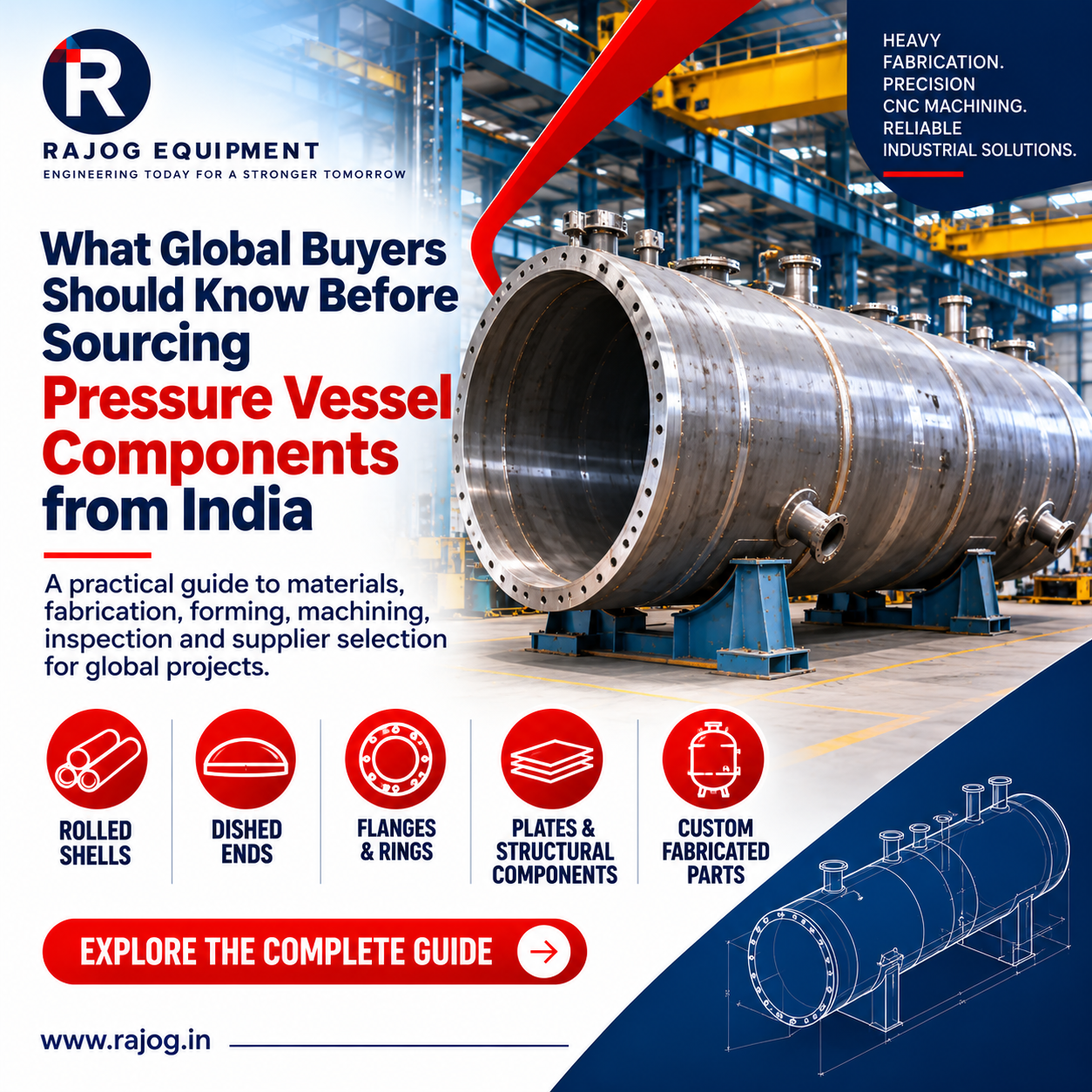
A pressure vessel is an engineered enclosure designed to contain liquids or gases at a specified pressure. Depending on its design and application, it may include a cylindrical shell, formed heads, nozzles, flanges, reinforcement pads, supports and internal components. Some buyers source a complete vessel, while others procure individual parts or subassemblies for integration at their own facility.
The scope should be defined clearly at the enquiry stage. A request for a rolled shell, dished end or machined component is different from a request for a fully designed, fabricated, tested and certified pressure vessel. Buyers should state whether they need components only, fabrication to supplied design, or a complete pressure equipment package.
1. Identify the Exact Component and Project Scope
Before approaching manufacturers, identify the components required and the work expected from the supplier. Common pressure vessel components include:
- Rolled shells and cylindrical sections.
- Dished ends and formed vessel heads.
- Cones, reducers and transition sections.
- Nozzles, flanges and reinforcement details.
- Tube sheets, support plates and related heat-exchanger components.
- Fabricated assemblies and machined interfaces.
Provide the latest approved drawings, bill of materials, quantities, material grades, dimensions, tolerances and project specifications. Clarify whether the supplier is responsible for design calculations, design review, fabrication only, machining, inspection or final assembly. Do not assume design responsibility is included when the buyer supplies drawings.
2. Check Material Specifications and Traceability
The purchase specification should identify the required material grade, product form, applicable material standard, thickness, heat-treatment condition and supplementary requirements. Buyers should define the material documentation and traceability expected for each component.
- Material test certificates and heat-number traceability, where specified.
- Verification of grade, thickness and product form.
- Positive material identification (PMI), if required by the project.
- Impact testing, heat treatment or other supplementary tests, where specified.
- Controls for material identification during cutting and fabrication.
The manufacturer should confirm that the specified material can be sourced, processed and documented within the project schedule.
3. Evaluate Plate Rolling and Forming Capabilities
Rajog publishes plate-rolling capability for cold and hot rolling, with stated thickness limits of up to 100 mm cold and 200 mm hot, and a published diameter range of 900-5,000 mm. These are published equipment capabilities, not a guarantee that every material, width, diameter and thickness combination can be processed together. Feasibility must be checked against the actual drawing and job conditions.
For formed heads, buyers should review available press capacity, forming span, material thickness, geometry, tooling and dimensional acceptance criteria. Rajog publishes dished-end and crown-petal forming capability up to a 5 m span, 110 mm thickness and 2,000-tonne press capacity. Suitability depends on the component design and material.
4. Review Fabrication and Welding Requirements
Ask the supplier to explain how fit-up, alignment, weld sequence and distortion are controlled. Confirm which welding processes and material combinations are within the supplier's qualified scope. Welding procedure qualifications and personnel qualifications should be reviewed against the governing code and project specification.
Rajog lists pressure vessel and boiler fabrication, heavy fabrication and inspection support for applicable projects. Buyers should confirm the exact fabrication scope, code requirements, welding qualifications and inspection arrangements for their enquiry.
5. Confirm Machining and Interface Requirements
The RFQ should identify datum references, tolerances, surface finish, hole positions and inspection methods for critical dimensions. Where machining follows fabrication, the manufacturing plan should account for allowances, distortion, handling and operation sequence.
Rajog publishes machining capabilities including CNC deep-hole drilling, CNC plano milling, floor boring and vertical turning. Buyers should compare the component envelope, weight, geometry and tolerance requirements with the specific machine capacities before confirming feasibility.
6. Define Inspection, Testing and Documentation Before Production
Inspection requirements should be agreed before the order is placed. The applicable design code, purchase specification and inspection and test plan (ITP) determine which checks are required, when they occur and who must witness or approve them.
- Material certificate review and traceability checks.
- Dimensional inspection at defined manufacturing stages.
- Weld visual inspection and other specified weld examinations.
- Non-destructive examination (NDE), such as radiography, ultrasonic, magnetic-particle or liquid-penetrant testing, where required.
- Pressure testing, such as hydrostatic testing, where required by the approved design and code.
- Heat-treatment records, coating records and final inspection documentation, where applicable.
- Third-party inspection and customer hold or witness points, where specified.
Not every test applies to every component. The buyer and supplier should agree the inspection scope, acceptance criteria, documentation format and release process before manufacturing begins.
7. Understand Applicable Codes, Standards and Certification
- Pressure equipment is subject to regulatory and technical requirements that vary by destination country, service, design pressure, temperature, fluid category and end use. Depending on the project, requirements may reference the ASME Boiler and Pressure Vessel Code, applicable EN standards, national regulations or other customer-specified codes.
- Buyers should identify the required code edition, jurisdictional requirements, conformity assessment route and any manufacturer certification needed before selecting a supplier. A supplier's general manufacturing capability does not automatically mean it is authorised or certified to design, manufacture, stamp or certify equipment under a particular code.
- Ask for documentary evidence of the exact certification, scope, validity and facility covered. Where the supplier manufactures components to a design supplied by another party, clarify which party holds design authority and which party is responsible for code compliance and final certification.
8. Assess Export Packing, Shipping and Delivery Planning
Pressure vessel components can be oversized, heavy or vulnerable to corrosion and handling damage. Export planning should begin during quotation rather than after manufacturing is complete.
- Confirm finished dimensions and shipping weight, including lifting and packing arrangements.
- Agree on preservation, rust prevention, protective covers and surface protection.
- Identify lifting points, centre of gravity and handling instructions where required.
- Confirm packing method, marking, documentation and destination requirements.
- Agree on Incoterms, freight responsibilities, insurance and customs documentation.
- Allow time for inspection release, packing, transport and port or destination constraints.
The supplier and buyer should agree on the delivery point and responsibilities in the purchase contract. Lead times should account for material procurement, manufacturing, inspection, rework contingencies and logistics.
9. How to Evaluate a Pressure Vessel Component Manufacturer in India
A structured supplier assessment helps international buyers compare manufacturing partners on a consistent basis. Consider the following:
- Technical fit: Can the supplier manufacture the specified material, geometry, thickness, diameter, weight and tolerances?
- Equipment capacity: Do rolling, pressing, welding, machining and handling facilities suit the actual job?
- Relevant experience: Can the supplier demonstrate experience with similar component types and industrial applications?
- Quality and traceability: Can the supplier meet inspection, documentation and material traceability obligations?
- Code and regulatory requirements: Does the supplier have the exact approvals or qualified scope required for the project?
- Production planning: Is the proposed manufacturing sequence, capacity and delivery schedule realistic?
- Export readiness: Can the supplier support packing, preservation, shipping documentation and agreed delivery terms?
- Commercial clarity: Does the quotation state inclusions, exclusions, assumptions, inspection costs and delivery conditions?
10. Why Consider Rajog for Pressure Vessel Components?
Rajog's website describes the following relevant manufacturing capabilities:
- Pressure vessel and boiler fabrication for applicable projects, with inspection support.
- Plate rolling, with published cold-rolling thickness up to 100 mm and hot-rolling thickness up to 200 mm; published diameter range 900-5,000 mm.
- Dished-end and crown-petal forming, with published span up to 5 m, thickness up to 110 mm and press capacity of 2,000 tonnes.
- Custom heavy engineering fabrication and machining of shells, dished ends, cones and industrial assemblies.
- CNC deep-hole drilling, CNC plano milling, floor boring and vertical turning for suitable component requirements.
For international buyers, the appropriate next step is to share the component drawing, material specification, quantity, applicable code, inspection requirements and delivery destination. Rajog's team can then review whether the requested scope matches its published equipment and manufacturing capabilities. Any required code certification, inspection, testing and export arrangements should be confirmed for the specific project before order placement.
11. What to Include in Your Request for Quotation (RFQ)
A complete RFQ reduces technical assumptions and helps the manufacturer prepare a more accurate proposal. Include the following information wherever available:
- Component description and whether the enquiry is for a part, subassembly or complete vessel.
- Latest approved drawings, drawing revision and bill of materials.
- Design code, applicable standards and project specifications.
- Design pressure, design temperature and service details where relevant to the scope.
- Material grade, thickness, product form and material documentation requirements.
- Dimensions, tolerances, weld details, machining features and surface finish.
- Inspection and test plan, NDE extent, testing and third-party inspection requirements.
- Quantity, delivery schedule, destination, packing and preferred Incoterms.
If design data is confidential, use the agreed confidentiality process before sharing. Clearly identify any information that is preliminary or subject to engineering approval.
Final Thoughts
Sourcing pressure vessel components from India can give global buyers access to a broad heavy engineering manufacturing base. The right supplier, however, must be selected against the actual technical scope - not simply the product name or headline machine capacity.
Buyers should verify material control, forming and fabrication capability, machining limits, inspection arrangements, applicable code requirements and export planning before placing an order. Clear drawings and a well-defined RFQ help both parties assess feasibility and avoid costly misunderstandings.
Rajog publishes capabilities in pressure vessel fabrication, plate rolling, dished-end forming, heavy fabrication and machining. International buyers can share their project requirements for a technical review and quotation discussion.
Key Takeaway
A successful pressure vessel component sourcing decision starts with a clear technical scope. Verify the manufacturer's actual capacity, material and quality controls, code-related responsibilities, inspection plan and export arrangements before awarding the order.