
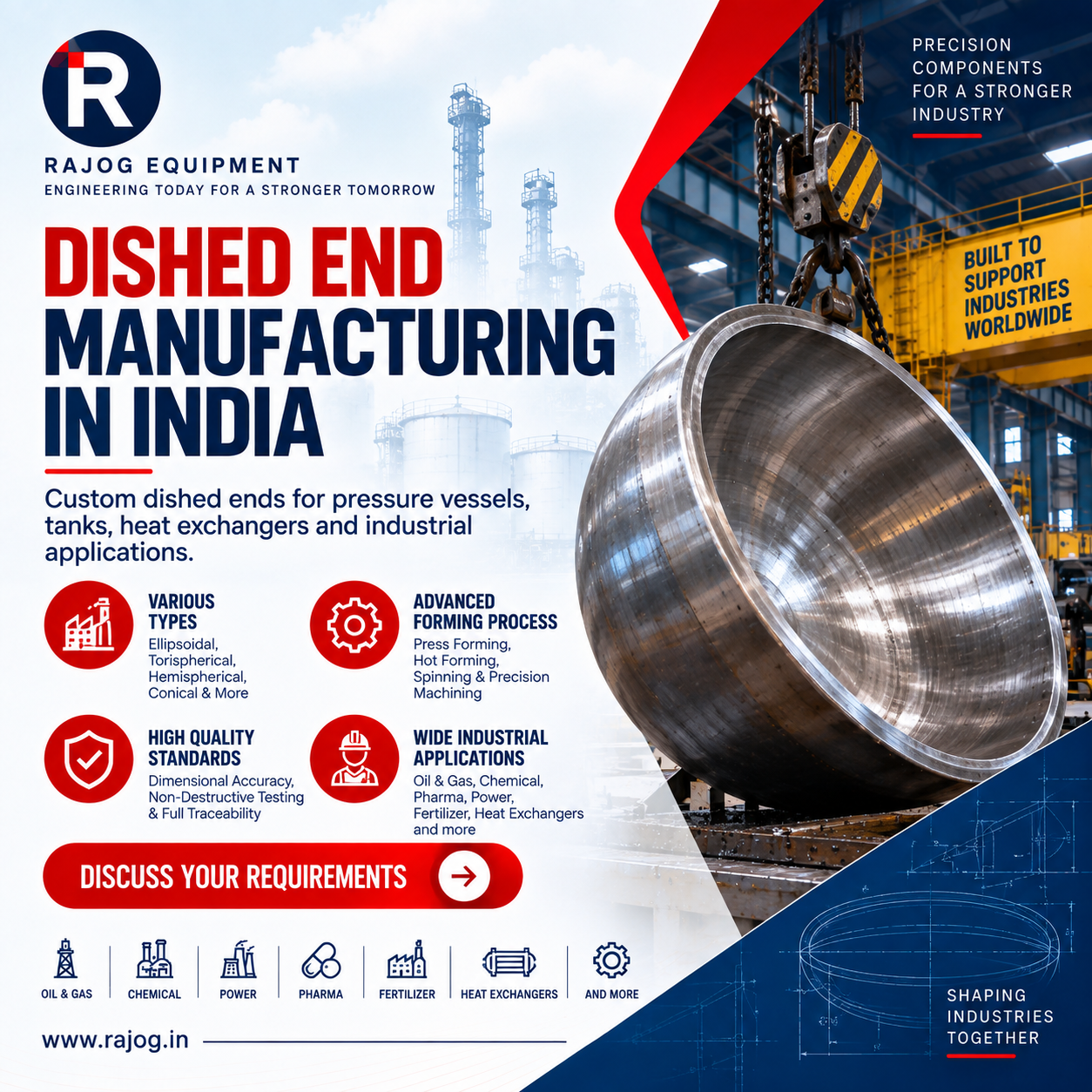
What Is a Dished End?
A dished end, also called a dished head or pressure vessel head, is a curved component fitted to the end of a cylindrical vessel or tank. Instead of using a flat plate, a curved head distributes pressure more effectively across the surface. This makes dished ends particularly useful for equipment that operates under internal or external pressure. Depending on the equipment design, a dished end can be manufactured in different geometries, including ellipsoidal heads, torispherical heads, hemispherical heads, conical heads, and flat or shallow dished heads.
Why Are Dished Ends Important in Industrial Equipment?
The ends of a pressure vessel experience significant mechanical stresses during operation. A properly designed and manufactured dished end can help distribute these stresses more efficiently than a conventional flat closure. Dished ends are important because they can provide better pressure resistance, improved structural performance, efficient vessel construction, and compatibility with demanding process conditions.
Types of Dished Ends
Different vessel designs require different head geometries. The appropriate geometry depends on operating pressure, temperature, material, diameter, thickness, and applicable engineering standards.
1. Ellipsoidal Dished Ends
Ellipsoidal heads have an elliptical profile and are widely used in pressure vessels and process equipment. A common configuration is the 2:1 elliptical head, although the exact geometry depends on the design requirements. These heads are commonly used in pressure vessels, storage vessels, reactors, heat exchangers, boilers and industrial process equipment. Their geometry provides a practical balance between pressure-handling capability, manufacturing requirements and vessel dimensions.
2. Torispherical Dished Ends
Torispherical heads combine a central curved section with a toroidal knuckle region. They are widely used in industrial vessels because they can offer a practical manufacturing solution for many pressure and process applications, including chemical equipment, storage tanks, pharmaceutical systems and heat-transfer equipment. The exact dimensions and allowable operating conditions should be determined according to the applicable design code and engineering calculations.
3. Hemispherical Dished Ends
A hemispherical head has a geometry close to half of a sphere. Because of its shape, it can provide highly efficient pressure distribution and is often considered for high-pressure applications. However, manufacturing a large hemispherical head can require more complex forming operations, specialized equipment and careful dimensional control. Typical applications include high-pressure vessels, specialized process equipment, reactors and high-pressure storage systems.
4. Conical Heads
Conical heads have a cone-shaped profile and are useful when material discharge, process flow or vessel geometry requires a tapered section. They are commonly found in chemical equipment, process vessels, storage systems, hoppers and industrial processing systems. The cone angle and transition geometry must be designed according to the equipment requirements.
Dished End Manufacturing Process
Manufacturing a dished end involves several stages. The exact process depends on the material, diameter, thickness, head geometry, quantity and applicable specifications. A typical sequence includes raw material selection, cutting, forming, heat treatment, trimming, edge preparation, inspection, finishing and final inspection.
Material Selection and Plate Cutting
- Carbon steel
- Stainless steel
- Low-alloy steel
- Alloy steel
- Nickel alloys and other specified engineering materials
Forming the Dished End
Forming is one of the most important stages in dished end manufacturing. The flat plate is transformed into the required three-dimensional shape using heavy hydraulic presses, hot forming, cold forming or metal spinning depending on the geometry and project requirements. The forming method should be selected based on the material, plate thickness, head diameter, geometry and required dimensional accuracy.
Quality Control and Inspection
Inspection is essential for pressure-vessel components. Typical checks may include diameter measurement, crown height, knuckle radius, thickness measurement, ovality, profile verification, surface inspection and edge condition. For critical applications, additional non-destructive testing may also be required. Quality control should be integrated throughout the manufacturing process rather than performed only near the end of the job.
Applications of Dished Ends
- Pressure vessels and storage tanks
- Reactors and process equipment
- Heat exchangers and boilers
- Chemical and petrochemical systems
- Pharmaceutical and food-processing equipment
- Water treatment and desalination systems
- Power generation and fertilizer plants
How to Choose a Dished End Manufacturer in India
- Verify forming capacity and machine capability
- Review material experience and relevant project history
- Evaluate inspection and testing capability
- Check welding and edge-preparation support
- Look for engineering coordination and drawing review capability
- Confirm heavy material handling and delivery planning
Final Thoughts
Dished ends are important components in pressure vessels, tanks, reactors, boilers and other industrial systems. Selecting the right head geometry, material, forming method, inspection process and manufacturing partner can directly influence the quality and reliability of the finished equipment. When sourcing dished end manufacturing in India, buyers should evaluate forming capacity, material expertise, inspection capability, engineering support, documentation quality and delivery reliability. For industrial projects requiring formed heads, pressure-vessel components, heavy fabrication or machining, working with a manufacturer that understands the complete production process can make project coordination easier and improve final equipment performance. For heavy fabrication and manufacturing capability, explore Rajog Equipment’s manufacturing capabilities.