
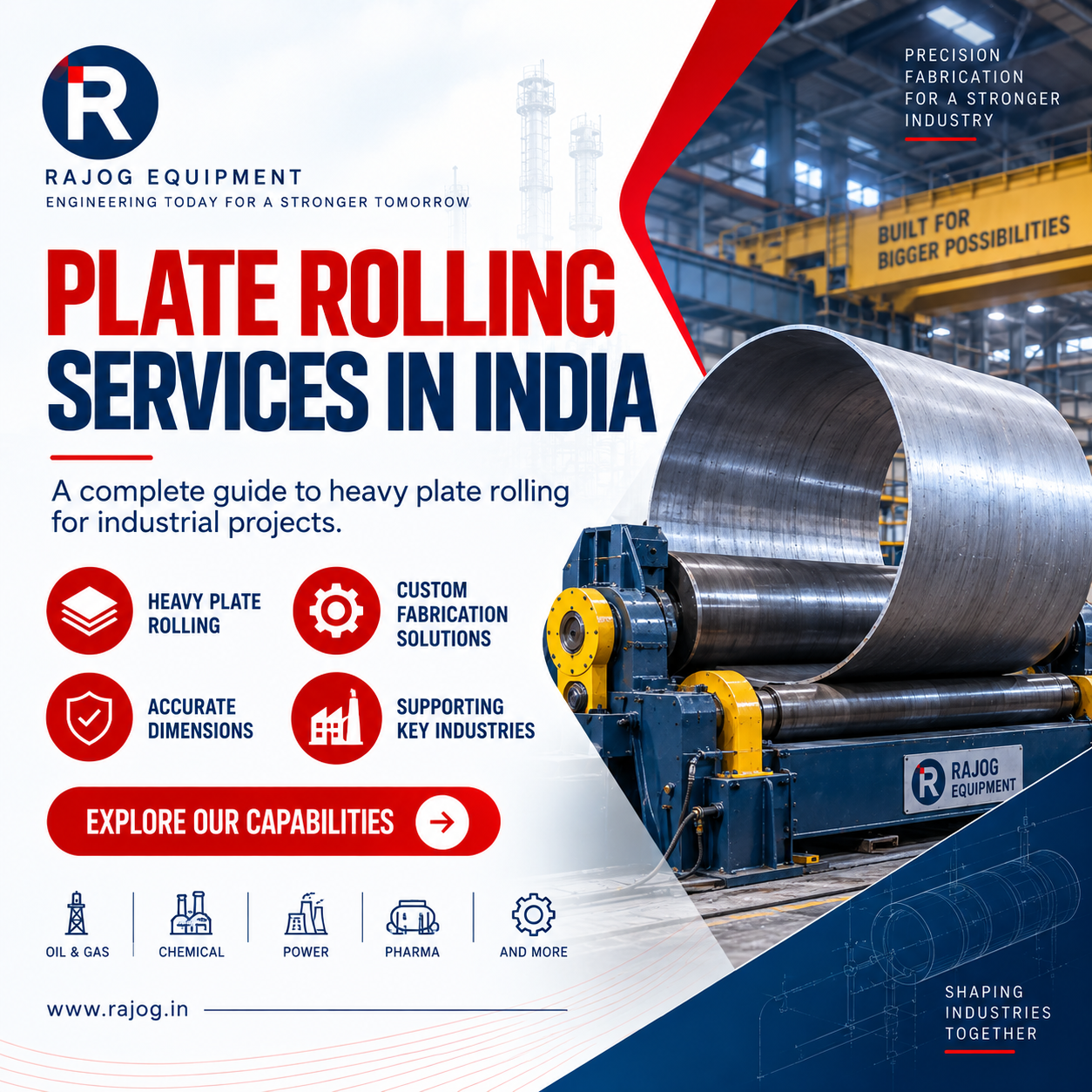
What Is Plate Rolling?
Plate rolling is a metal forming process in which a flat metal plate is passed through a set of rollers to achieve a required radius or curved shape. Depending on the project requirement, plates can be formed into cylindrical sections, conical sections, curved components, shell sections, tank bodies, pressure vessel shells and custom fabricated shapes. The rolling process is selected based on the material, plate thickness, required diameter, component length and final application.
Why Is Plate Rolling Important in Heavy Engineering?
Many industrial components require large metal plates to be formed accurately before they can be welded and assembled. For example, a pressure vessel shell may start as a flat steel plate that must be cut to the required dimensions and rolled to achieve the specified diameter. Accurate plate rolling supports proper fit-up, consistent dimensions, better welding alignment, reduced rework, improved fabrication efficiency and easier assembly.
Types of Plate Rolling Processes
- Three-roll plate rolling: Three-roll machines progressively form plates into the required radius and are commonly used for cylindrical and curved components.
- Four-roll plate rolling: Four-roll machines provide greater control over the plate during forming and can reduce handling when accurate forming is important.
- Cone rolling: Controlled forming creates conical components. This requires appropriate machine setup and technical control because forming conditions vary across the plate width.
What Factors Affect Plate Rolling?
- Material: Carbon steel, stainless steel and alloy steel have different strength and forming characteristics.
- Plate thickness: Thicker plates require greater forming force and suitable machine capacity.
- Plate width: The plate width must be within the rolling equipment capability.
- Required diameter: The finished diameter determines the rolling setup and forming process.
- Material properties: Yield strength, tensile strength and material behavior affect the force required.
- Rolling accuracy: Required dimensional tolerances should be considered during process planning and inspection.
Heavy Plate Rolling for Industrial Projects
Heavy plate rolling is important when manufacturing large industrial components such as pressure vessel shells, storage tanks, heat exchanger components, industrial vessels, structural components, process equipment, heavy machinery and large fabricated assemblies. These applications require suitable rolling machinery and experienced operators who understand the relationship between material properties, thickness, diameter and forming force.
Plate Rolling for Pressure Vessel Manufacturing
Pressure vessels are a major application of plate rolling. During fabrication, large steel plates are rolled into cylindrical shell sections that are then fitted, welded, inspected and assembled with other vessel components. The rolling process must achieve the required diameter, roundness, length, edge alignment and dimensional tolerances. Accurate rolling helps simplify subsequent fit-up and welding stages.
Plate Rolling and Welding
Plate rolling and welding are closely connected in heavy fabrication. After a plate is rolled, its edges must be properly aligned before welding. If the rolled shape is inaccurate, it can result in fit-up difficulties, increased welding time, additional correction work, dimensional variations and production delays. Plate rolling should therefore be planned together with the overall fabrication process.
Quality Control in Plate Rolling
After forming, the component may be inspected for diameter, roundness, length, thickness, edge alignment, surface condition and overall dimensional accuracy. Inspection requirements depend on the component design and project specifications. Proper inspection helps identify dimensional issues before the component moves to the next stage of fabrication.
How to Choose Plate Rolling Services in India
- Machine capacity: Check the maximum plate thickness, width and diameter the manufacturer can handle.
- Material experience: Confirm experience with the required material grades.
- Heavy engineering experience: Experience with large industrial components is valuable for complex projects.
- Dimensional control: Ask about inspection methods used to verify rolled components.
- Fabrication integration: Cutting, welding, fabrication and machining capabilities can simplify coordination.
- Lifting and handling facilities: Heavy plates and rolled shells require suitable cranes and handling equipment.
- Quality documentation: Industrial projects may require inspection records and material documentation.
- Delivery capability: The supplier should support the required rolling and fabrication schedule.
Benefits of Professional Plate Rolling Services
- Better dimensional accuracy through suitable machinery and process control.
- Reduced rework during fit-up and welding.
- Improved fabrication efficiency through properly formed components.
- Support for larger and thicker plates used in industrial projects.
- Better coordination between rolling, fabrication, machining and inspection teams.
Industries That Use Plate Rolling
- Oil and gas
- Chemical processing
- Power generation
- Pharmaceuticals and fertilizers
- Heat transfer and desalination
- Steel, cement and sugar
- General heavy engineering
Plate Rolling vs Other Metal Forming Processes
Plate rolling is primarily used when a flat plate needs to become a curved, cylindrical or conical form. Press forming may be more suitable for controlled deformation through pressing, bending for smaller or localized bends, and forging for significant material deformation under high force. The correct process depends on component geometry, material, dimensions and engineering requirements.
Why Integrated Fabrication Capability Matters
For large industrial projects, plate rolling is usually only one stage of manufacturing. A typical project may involve Material Procurement -> Cutting -> Edge Preparation -> Plate Rolling -> Fit-Up -> Welding -> Inspection -> Machining -> Final Inspection -> Dispatch. When multiple capabilities are available through one manufacturing partner, coordination becomes easier and unnecessary movement of large components between suppliers can be reduced.
Questions to Ask a Plate Rolling Manufacturer
- What is your maximum plate rolling thickness and width?
- What diameter range can you achieve?
- Can you handle stainless steel and alloy steel?
- Do you provide cone rolling?
- What dimensional inspection methods do you use?
- Do you also provide fabrication and welding?
- Do you have heavy lifting facilities?
- Can you support machining after fabrication?
- What is the expected production lead time?
What Information Should Be Provided for a Plate Rolling RFQ?
- Material grade
- Plate thickness, width and length
- Required diameter and shape
- Quantity and drawing
- Dimensional tolerances
- Inspection and welding requirements
- Delivery location and required delivery date
Final Takeaway
Plate rolling is a critical process in the fabrication of many large industrial components. The right combination of machine capacity, material expertise, forming accuracy, inspection, heavy handling and fabrication experience can make a significant difference in project execution. For buyers looking for plate rolling services in India, it is important to evaluate the manufacturer's complete technical capabilities rather than comparing price alone. For industrial projects requiring heavy plate rolling, fabrication and precision engineering, explore Rajog Equipment's manufacturing capabilities.