
Introduction
Pressure equipment projects in the Gulf require careful control over engineering, materials, fabrication, machining, inspection, documentation and delivery. For EPC companies, process equipment manufacturers and procurement teams in the UAE, Saudi Arabia, Qatar, Oman, Kuwait and Bahrain, selecting an Indian manufacturing partner can be an important sourcing decision. Evaluate technical suitability and project reliability—not quotation price alone.
Define the Component Requirement First
Before contacting suppliers, prepare the component type, material, dimensions, thickness, weight, quantity, fabrication and machining scope, inspection and documentation requirements, delivery location and schedule. A detailed RFQ helps manufacturers assess the project and identify technical questions.
Common Pressure Equipment Components
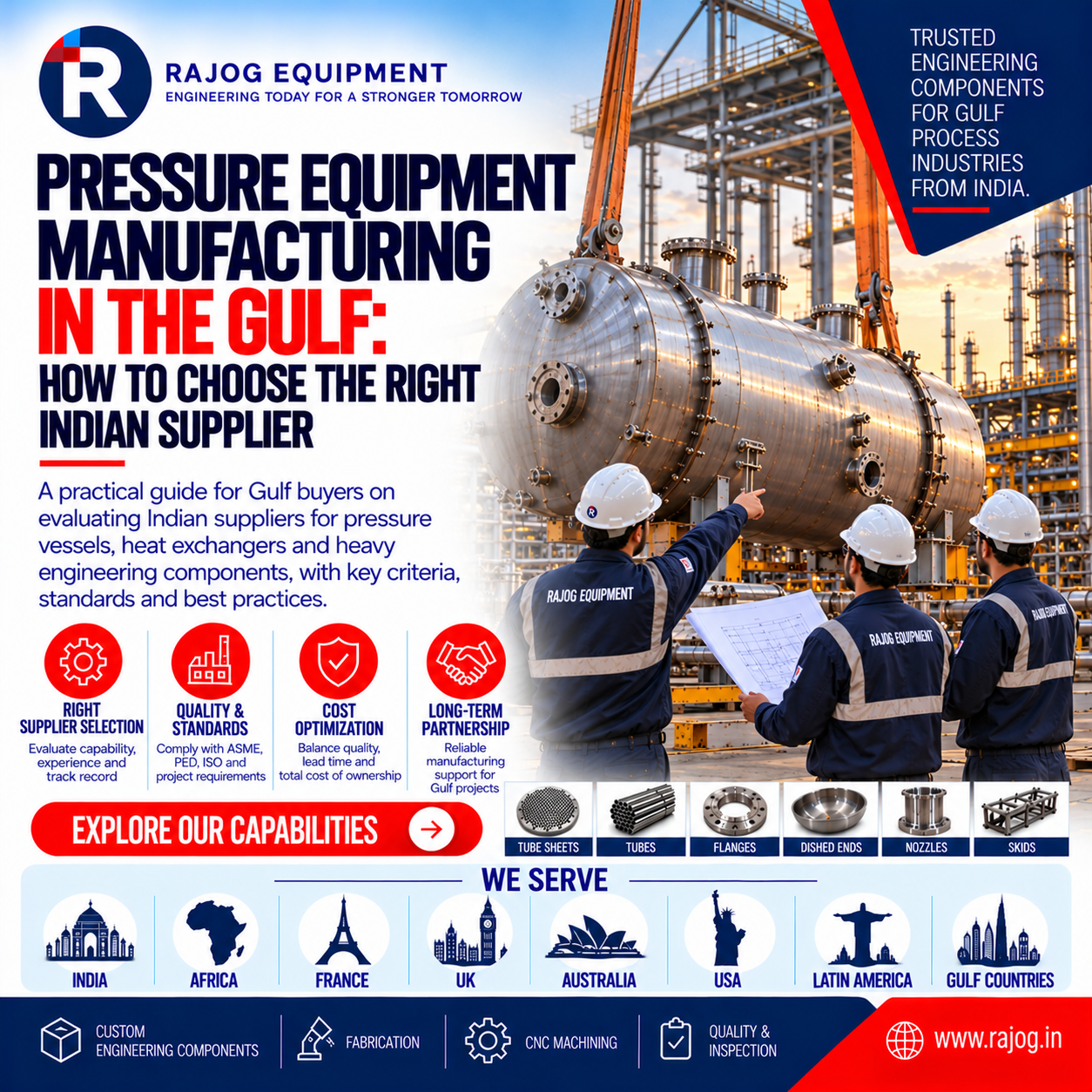
Depending on the project design, procurement may include tube sheets, rolled shells, dished ends, nozzles, heavy flanges, supports, skids and custom fabricated components. Each component may call for different processes, capacity and inspection, so qualify the supplier for the actual scope.
1. Check Manufacturing Infrastructure
Confirm the supplier has suitable plate cutting, rolling, forming, welding, CNC machining, drilling, heavy lifting and inspection capability. Compare real equipment limits and facilities with the component drawings, dimensions, materials and weight.
2. Evaluate Engineering Review
Before production, ask the supplier to review material availability, fabrication sequence, welding access, machining allowances, dimensional control and inspection requirements. Resolve manufacturability questions and approve any drawing clarifications through the project’s documented process.
3. Agree Quality Controls and Records
Pressure equipment procurement may require material certificates, welding records, NDT reports, dimensional inspection, surface inspection and final inspection documentation. Requirements vary by project; define applicable standards, acceptance criteria, hold points and records before manufacturing starts. Certification should never be assumed—specify applicable certification and documentation in the RFQ and purchase order.
4. Confirm Capacity and Heavy Handling
Ask about maximum component dimensions and weight, crane and machine capacity, shop access and loading facilities. Confirm that the component can be safely handled through fabrication, machining, inspection and dispatch, including the lifting points and movement plan where relevant.
5. Plan Delivery and Export Logistics
International procurement requires early logistics planning. Discuss export packing, corrosion protection, lifting points, shipping dimensions and weight, port handling and delivery terms. Identify any transport limitations before manufacturing is complete so that packaging and dispatch can be planned appropriately.
Compare Indian Suppliers Using a Consistent Scorecard
Assess each supplier against the same criteria:
- Technical capability: Can it manufacture to the approved requirement?
- Capacity: Can it handle component dimensions and weight?
- Quality: Are inspection processes and records suitable?
- Documentation: Can required records be supplied and controlled?
- Engineering: Can manufacturing risks be identified early?
- Delivery and logistics: Is the production and export plan realistic?
Why an Integrated Supplier Can Help
Conclusion
Choose an Indian pressure equipment manufacturing partner based on technical capability, infrastructure, quality, engineering support, capacity, documentation and delivery reliability. A structured supplier qualification process can reduce manufacturing and procurement risks while improving project visibility.